|
New Theories in Dinosaur Science
Montana Dig Site Yields Clue to an Ancient Past
by Taylor Kilgore, age 15
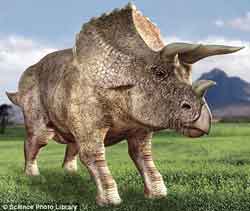 Imagine a species where individuals change their appearance so dramatically by adulthood that they appear to be an entirely different individual. The skull transformations of the great three-horned triceratops and the dome-headed pachycephalosaurs seem to have been just this dramatic.
These dinosaurs are studied by paleontologist Jake Horner and his team. The team has been conducting fieldwork in Montana studying fossil collections for the University of California’s Museum of Paleontology.
Horner and his team have been studying these unique creatures in an effort to better understand dinosaur growth and behavior. The team is curious to study why these dinosaur skulls went through such extreme changes during the animal’s lifetime. The skull change is so extreme that juveniles and adults of the same dinosaur are often mistaken as different species.
Horner’s team noticed that the skulls changed structure and function throughout the dinosaur’s development. Various bumps and nodes were unique to each individual. The team hypothesizes that these variations were for display and visual communication, allowing juveniles to recognize adults and vice-versa. A second hypothesis theorizes that the bumps, nodes, and changing skull shapes were used for defense.
The forever-changing Triceratops had the biggest skull of any animal that ever walked the earth. It is also the most recognizable horned dinosaur from North America. You might even remember the sassy Triceratops from the children’s cartoon, Land Before Time. This famous dinosaur’s name is derived from the three horns on its face, one on the tip of its nose and two above its eyes.
In 1995, in eastern Montanan, Harley Garboni discovered the smallest and youngest triceratops skull. Until then, only adult skulls had been found and studied. This skull led to many new observations. For instance, scientists noticed that baby triceratops had tiny, straight horns surrounding strange bony shields or frills.
Horner and his team used a growth series of Triceratop skulls to show that in a juvenile triceratops, the horns above the eyes curve surprisingly backwards. As the animals grew into adulthood, the horns actually reversed direction and pointed forward. By observing these skulls the researchers found that triceratops likely did not use their massive skulls for defense due to their very hollow postorbital horns.
Many movies, books, and even scientists have portrayed the pachycephalosaur using their domes to fight over mates. They were even nicknamed “Dinosaurian Battering Rams” by one paleontologist, who suggested that the domes were used for ramming in the same way as big horn sheep use their horns in combat. Rams, however, have special features that protect their brains during fights.
More than 30 pachycephalosaur skulls were studied to determine if they had these special features. Skulls were cut open by hand as well as digitally. These dissections showed the domes were solid, unlike the big horned sheep. Sheep have a hollow “air” chamber protecting their brains.
In a young pachycephalosaur skull “bony fibers” were found which would have given them an advantage in head butting. However, as a pachycephalosaur grew, the protective fibers disappeared. Thus the idea that the pachycephalosaur used its dome to fight may sound cool, but it just is not the case
The hypothesis and research work of Jake Horner and his team confirm that the massive skulls and domes of these dinosaurs were used for display and visual communication. Juveniles recognized adults and adults recognized juveniles by skull shape. Ultimately, making observations and hypotheses about dinosaurs, like other animals, is a productive way of understanding them.
[Sources: www.digonsite.com; Atlas of Planet Earth]
|