|
Previously Unknown Dinosaurs Unearthed in Antarctica
by Sean Hinds, age 17
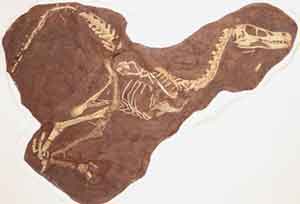 Rarely do scientists discover two unique dinosaur species on the same continent within the same month. But they accomplished just that in December 2003—on Antarctica.
One of the animals discovered was a carnivore. Scientists found its remains at the bottom of the ocean. The other new discovery is that of a herbivore. Its skeleton was unearthed at a mountaintop thousands of miles away.
Judd Case, dean of science and professor of biology at St. Mary’s College of California, James Martin, curator of vertebrate paleontology at South Dakota School of Mines and Technology, and their team of researchers discovered the carnivore. It was found near James Ross Island, off the coast of the Antarctic Peninsula. Millions of years ago, when this dinosaur lived, the Antarctic landscape resembled today’s Pacific Northwest.
The team recovered most of the animal’s lower legs and foot bone, along with fragments of the upper jaw and a few teeth. Based on these bones, researchers infer a number of traits this dinosaur likely possessed.
Martin suggests that the size and shape of the leg bones demonstrate that the animal stood roughly 1.8 to 2.4 meters tall, and was capable of running. Its legs and teeth share characteristics with the dinosaur group known as theropods, meaning “beast-footed” creatures. This extensive and diverse group, which includes the famous T-Rex, had the ability to walk on two legs as modern birds do. Scientists believe theropods are the ancestors of modern birds.
William Hammer of Augustana College in Rock Island, Illinois, and his team discovered the herbivore. Hammer is known for his 1991 discovery of cryolophosaurus ellioti at Beardmore Glacier in Antarctica. A potentially dangerous overhang he created in a rock face during this earlier excavation temporarily halted further research. After the overhang was cleared, Hammer and his team returned to the site.
In 2003 the team made another fascinating discovery. In what was soft riverbed millions of years ago, and is now the rocky 13,000 ft summit of Mt. Kirkpatrick, they uncovered a three-foot-wide pelvis.
Hammer and his team believe this pelvis belonged to a primitive sauropod, a four-legged herbivore-like brachiosaurus or diplodocus. This creature was likely 1.8 to 2.1 meters tall and as much as nine meters long. While it was not particularly massive compared to other dinosaurs, it was part of an emerging class that would eventually evolve to include huge animals over 30 meters long.
December 2003 proved an exciting month for dinosaur research in the Antarctic. Researchers continue to search Antarctica. It is very likely that this remote continent will yield more exciting discoveries like these.
[Sources: National Science Foundation; Discover]
|