|
|
Skeleton Uncovered in Ethiopian Desert Changes Science Forever
by Dianna Soma, age 16
 A famous archeological site known as Hadar is located in Ethiopia’s Afar desert in East Africa. The sun-baked landscape is extremely harsh and temperatures routinely reach 110 degrees Fahrenheit.
This place may seem too inhospitable to be the home of our earliest ancestors, but three million years ago, Hadar was not a scorching desert. Rather the area was a mixture of grasslands and lush woodlands.
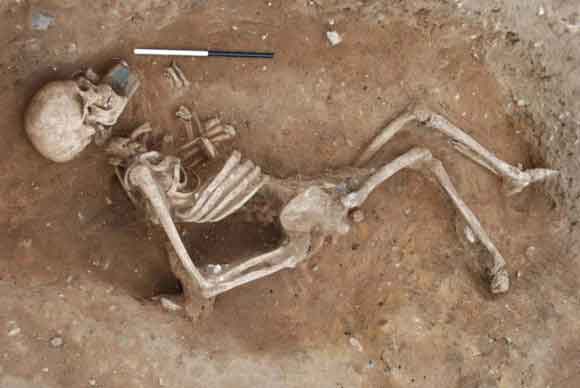
In 1974, Donald Johanson, then a curator at the Cleveland Museum of Natural History and Tom Gray, a graduate student, discovered an elbow bone fragment embedded in a rocky slope. Further excavation at the site yielded more bones, and more clues. Eventually, scientists uncovered 40 percent of a female Australopithecine skeleton.
The species was given the scientific name Australopithecus afarensis, but this particular skeleton is most commonly known as “Lucy.”
Lucy may be an early human ancestor but, at three feet and seven inches tall, with both ape and human features, she does not look anything like a modern human. Lucy and the rest of her species had jutting jaws, a heavy brow, and a brain more ape-like than human.
Analysis of her bones and skeletal structure reveals that, unlike her ape cousins, Lucy walked on two legs. Damage on her teeth suggests her diet was filled with fruit, nuts, and possibly termites and lizards.
Initial estimates of Lucy’s age ranged from 3.6 to 2.9 million years old, though more recent advanced dating technology shows she lived 3.18 million years ago.
At the time of her discovery, Lucy was the oldest, most complete Australopithecine skeleton ever found. Finding such a complete 3-million-year-old skeleton is exceptionally rare. Had Johanson and Gray not discovered Lucy on that day, future rain would have washed away the remnants of her existence.
Further excavations in the Hadar region have been the cause of debate among researchers. Other fossils were found that were much larger than Lucy’s, causing some scientists to suggest there were two species of Australopithecus that differed in size. Others contest that there was one single species where males were much larger than females, just like modern gorillas.
Raymond Dart, then a professor at the University of Witwatersrand in Johannesburg first discovered Australopithecine fossils in 1924 in South Africa. Dart believed his discovery was a missing link between apes and humans. At the time, the idea was not widely accepted. As more Australopithecine fossils have been unearthed, however, the theory has gained widespread support.
Lucy is no longer our oldest found ancestor. Since her discovery, scientists have unearthed hundreds of older fossils that contribute to our knowledge of the human family tree. Though she isn’t the oldest, she is an important link in human evolution. Lucy represents a beginning in our human history, when our ancestors began walking on two legs.
[Source: Tombs, Graves, and Mummies]
|
|