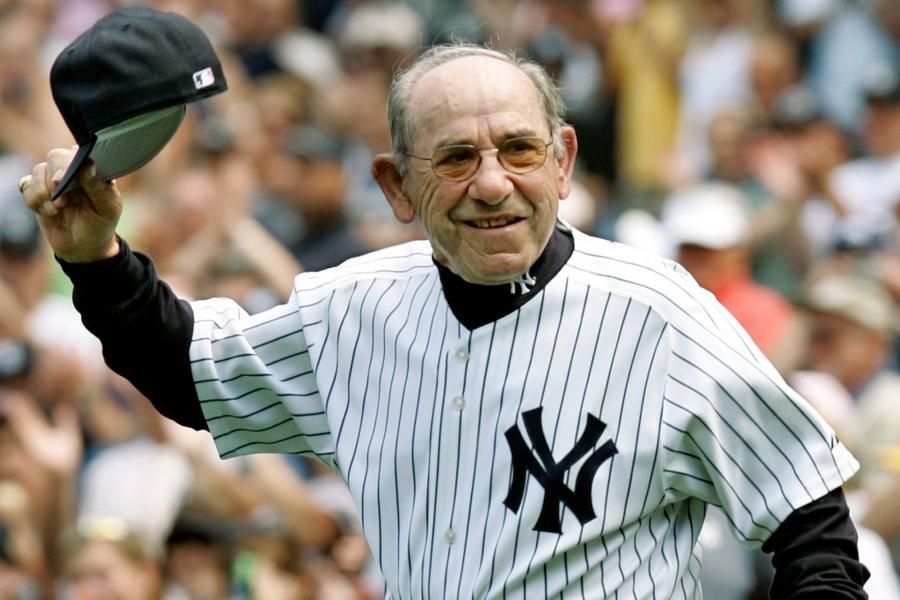
Yogi Berra’s Story, From D Day to the Yankees
by Oliver Zink, age 14
Yogi Berra was one of the most talented and most influential baseball players and an American icon. He was the child of Italian immigrants, a World War II gunner, a record-holding athlete, and a baseball manager. He had a long, successful life and baseball career that all started with playing baseball in sandlots as a kid.
Yogi was a first-generation Italian American who grew up in a St. Louis neighborhood called “The Hill.” While there, he was surrounded by fellow Italian immigrants, which helped him grow up with a sense of community and Italian traditions.
Yogi's father, Pietro, came to the United States by himself in 1909 from Malvaglio, a northern Italian town near Milan. He temporarily left his wife and two kids in Italy, but eventually settled in St. Louis and had his family follow soon after. While in St. Louis, Pietro had three more children – the second one was Yogi.
Yogi started playing baseball with kids in his neighborhood. After quitting school in 8th grade, he joined the American Legion Baseball League and showed remarkable skill. The only problem was that work interfered with baseball, so he stopped working for his dad and focused on his athletic career.
When he tried out for the St. Louis Cardinals, his friend Joe Garagiola was offered a $500 sign-on bonus, while Yogi only got a $250 sign-on bonus. Yogi thought it was unfair because he thought they had the same skill level. Yogi was only offered $250 by the St. Louis Cardinals to save him for the Dodgers, who were going to offer him $500. The plan backfired when Yogi was offered $500 from the Yankees, and he accepted. He started his career in the team’s Class B affiliate in Norfolk, Virginia.
World War II immediately interfered with his baseball career. At 18, he joined the Navy. He would see France, Italy, and North Africa during wartime. He fought in one of the most influential battles of the war, D-Day. When he was honorably discharged in 1945, Yogi started playing baseball again.
When he returned post-war, he joined the Newark Bears, the Yankees’ top Minor-League affiliate. In late 1946, he was called up to the Major League, hitting a home run in his first game against Philadelphia. His long, successful MLB career was just starting.
With his experience fighting in World War II and playing in the MLB, he was seen as an American success story. However, people did not see the other side of his life. As the son of Italian immigrants, he experienced racism from a young age. This continued into his career in the MLB, where he was often called offensive names and slurs. Italians were classified as a “colored” group, a name that came with prejudice. Yogi learned from his experiences and developed more empathy towards others.
The Yankees team that Yogi joined had many legends, namely JoeDiMaggioo. Dimaggio held the record of most consecutive hits: 56. Legendary catcher Bill Dickey retired just as Yogi joined, but he would return to coach during Yogi's first years with the Yankees. Yogi credited Dickey for teaching him the art of being a catcher. Dickey did not just play with DiMaggio but also with Babe Ruth and Lou Gehrig. He passed baseball knowledge onto Yogi. However, Yogi learned the most from coach Casey Stengel.
Stengel was the perfect teacher for Yogi Berra, though the whole Yankees team benefited from his coaching. They won five World Series in a row, an MLB record that still stands. Stengel had a unique way to approach publicity. He was known for his phrases and wordplay, and he passed that trait down to Yogi. His way of talking had humor and deep wisdom – his words undoubtedly influenced Yogi. When Yogi was promoted from being a player to a coach, Stengel’s influence stuck with him, and he carried on this wisdom.
Though Yogi already had a successful career playing for the Yankees in 1946, he remained living in St. Louis until 1951. In St. Louis, he met his future wife, who was a waitress at a restaurant he could not afford to eat at. However, that did not stop him from going there often and just ordering water. He worked up the courage to ask her on a date, and when she said yes, they went to a hockey game. They eventually got married in 1949, ultimately settling down in Montclair, New Jersey, and living there for 50 years. They were married for 65 years and had three children: Larry, Tim, and Dale.
During Yogi's time at the Yankees, he was known as a clutch hitter and a talented catcher. He went 148 straight games without making a mistake as a catcher. He broke many records: the most unique one was catching for Don Larson’s perfect game in the 1956 World Series, the only one to ever occur in that tournament. He was also a great hitter and rarely struck out, swinging for wild pitches and sometimes hitting them.
He won many awards throughout his career. He was an All-Star for 15 seasons and won the American League MVP three times. He was named a member of the All-1900s MLB Team. He also won ten World Series. When he retired, he started a new chapter in his life and in his baseball career. He coached and managed the Yankees, but then left and won another championship as the manager of the 1969 Miracle Mets. He left to coach the Yankees again in 1976 and won both the 1977 and 1978 World Series. He was later fired and went to the Houston Astros. In 1999, he rejoined the Yankees as the elder spokesman.
After he retired, he became baseball's unofficial ambassador. Even after retiring from Major League Baseball, he still helped Yankees players in spring training. He passed away on September 22, 2015. Even though he had acquired so many awards, he stayed a humble American icon and will be remembered as one.
[Source: Yogi Berra Museum]











Loading Comments...