New Shot Clock Rules Could Change the Game for High School Basketball in Wisconsin
by Kai Palreddy-Lowe, age 11
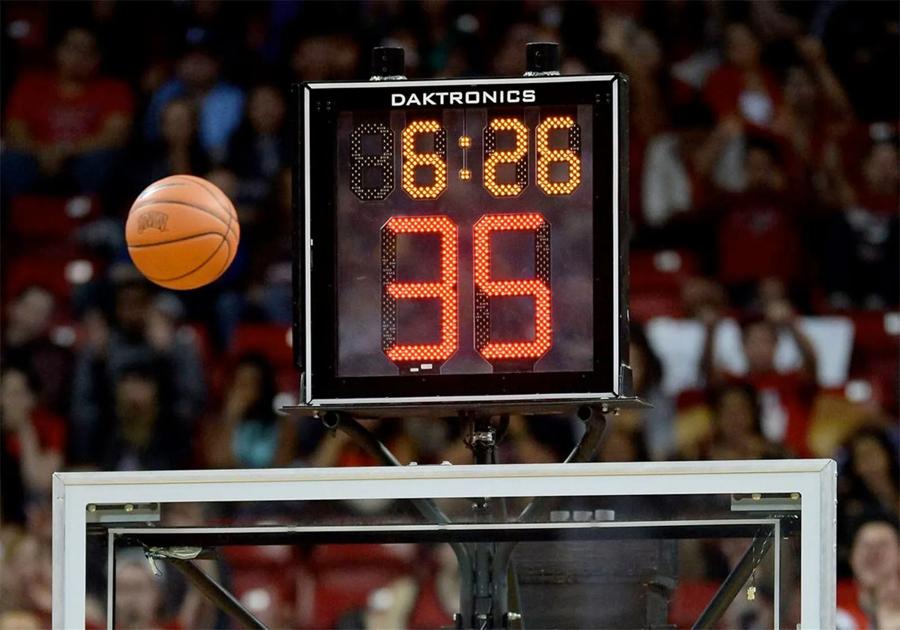
The Wisconsin Interscholastic Athletic Association, also known as the WIAA, has made a decision that could evolve into changing basketball at the high school level in Wisconsin permanently: they have approved limited use of a 35-second shot clock during high school games when there is mutual agreement between the teams to use it.
The limitation is that it can only be used in nonconference games. This implementation would change a lot of things for schools, including school budgets, as the shot clocks can cost over $2,500 as well as trying to find people who can operate them during games. The cost and staffing are a main reason why the WIAA is only making shot clocks optional during games.
The shot clock is an important part of professional and college basketball, and now it is moving to high school basketball too. They are used in basketball as a way to speed the game up, rather than having one team hold the ball for an entire half if they wanted to. The rule for the shot clock is that a team cannot hold possession of the ball for more than an established time limit; otherwise, the other team is given the ball. The time limit in college basketball is 30 seconds, although in pro, it is 24 seconds.
Another part of this complicated rule is that if the shot clock goes off when the player is in the act of shooting, and the shot goes in, the shot does not count. If, however, the ball is in the air when the shot clock goes off, and it goes in, the shot does count. If a shot misses after the shot clock goes off, it has to hit the rim for the team to have an offensive rebound, if the shot does not hit the rim, the team will not be able to obtain possession of the ball, and if the team succeeds in getting the offensive rebound, the shot clock is reset, but not to its full capacity.
The implementation of the shot clock will affect high school basketball in many ways; one of the biggest being pace of play, as the teams have only 35 seconds to get a shot off. This will make it so there are more shots, and this will also lead to higher scoring games, with scores getting closer to those of college basketball.
The shot clock will also affect shot selection. Players will have less time to choose the best shots, so the quality of shots, along with players’ shooting percentage, may go down. This may also shape how coaches plan their offenses, trying to get the best shots possible in the 35 second time limit.
Even though the WIAA has only implemented the shot clock partially this year, other states have been using shot clocks for years now. The NFHS which governs high school sports and which the WIAA is a member of, gave states the option to implement a 35 second shot clock in 2021, which has since been adopted by Iowa and Minnesota, and is being adopted by Illinois and Wisconsin for the 2026-27 season. Michigan is the only Wisconsin border state that is not using a shot clock, although they have experimented using it in past tournaments and special events.
The shot clock is not the only rule change this year, as lots of rules were changed especially for tournament play. One example of a rule change in tournaments is that the higher seeded team will now always be given the status of home team, and will wear lighter colored jerseys. Another rule change is the removal of a rule stating that teams who participate in the state tournament cannot be moved down to a smaller division the following year under any circumstances. With all these rule changes, Wisconsin high school basketball will look very different from before.
The decision that the WIAA made will certainly change the 2026 high school season and maybe even high school basketball in future seasons, as this season is only to test the shot clock out. The shot clock will be voted on permanently in April 2027. While the shot clock makes games faster and more exciting, several rural schools pushed against it at the start because of the price of the shot clock. Adding a shot clock may be a good decision or it may be a bad one, but it really depends on what point of view you are looking from.
[Sources: The Milwaukee Journal Sentinel; Civic Media; The Monroe Times]











Loading Comments...