The Life and Legacy of Diego Maradona
by Shalom Harimana, age 15
Within the debate regarding the greatest soccer player of all time, it is guaranteed that Diego Maradona will be brought into the conversation.
Maradona was born on October 30, 1960. He grew up in Villa Fiorito, Argentina, in poverty. However, that did not stop him from achieving his dreams. To name a few of his accomplishments, he played for the Argentina National Team, competed in four World Cups, played for eight clubs, and was named FIFA Player of the Century, a title he shared with Pelé in 2000.
At the age of three, his love for soccer began when he received a ball from his cousin as a birthday present. From then on, it became his constant companion. At eight years old, he tried out for Argentinos Juniors. The coaches were amazed by his talent and initially couldn’t believe his age. After checking his ID, they welcomed him and helped him develop his skills. Although too young to join the senior team, Maradona became a halftime entertainer, performing tricks with a ball and even an orange. He soon gained national attention and appeared on television.
At 15, Maradona made his official debut for Argentinos Juniors’ first team, becoming the youngest player in Argentina's top division at that time. A few months later, in February 1977, he debuted for the Argentina National Team in a friendly match against Hungary. Despite his growing fame, he was excluded from Argentina's 1978 World Cup squad, which was a devastating blow.
Maradona spent five years at Argentinos Juniors, scoring 116 goals in 166 appearances. Around this time, he met Claudia Villafañe, who later became his wife. When he was ready for a move, he received several offers. River Plate offered the most money, but Maradona chose Boca Juniors, his childhood favorite team. In just one season, he scored 28 goals in 40 appearances and led Boca to a league title, fulfilling a dream.
He played in his first World Cup in 1982 in Spain, but it was a difficult tournament. He was repeatedly targeted with fouls, and tensions within the team affected Argentina’s performance. They failed to reach the semifinals after a loss to Brazil.
After the World Cup, Maradona transferred to FC Barcelona for a then-record $7.6 million. In 1983, he became the first player to receive a standing ovation from Real Madrid fans at the Santiago Bernabéu after a brilliant goal in El Clásico. However, his time in Spain was marred by injuries and controversy. Constant fouling led to a serious ankle injury. In 1984, after a mass brawl during the Copa del Rey final against Athletic Bilbao, Maradona was transferred out under pressure from the Spanish monarchy and fans.
He then joined Napoli in Italy for another record fee of $10.5 million. A local newspaper famously wrote that Naples lacked basic necessities like schools and sanitation, but none of that mattered because they now had Maradona. He transformed Napoli, helping them finish third in Serie A his first season and eventually leading them to two league titles, a UEFA Cup, and multiple domestic trophies.
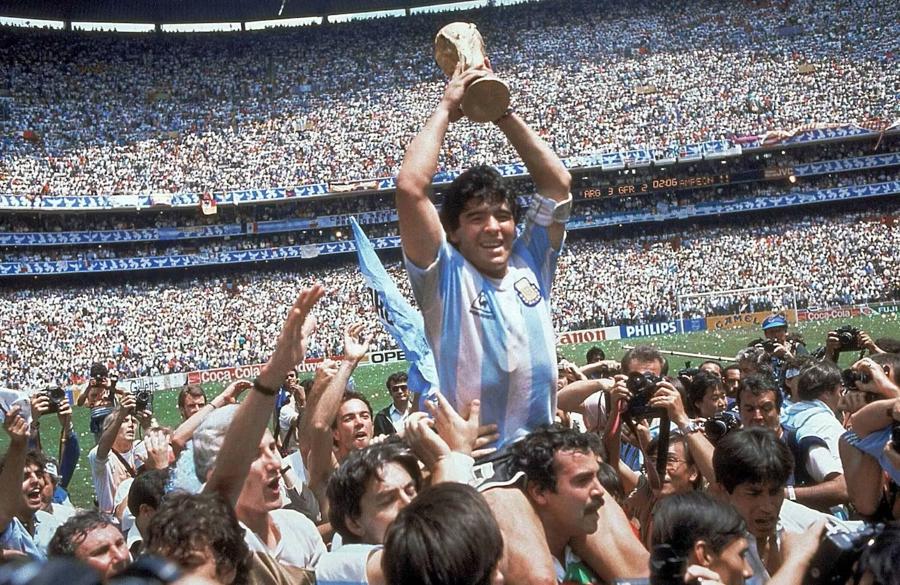
In the 1986 World Cup in Mexico, Maradona was at the peak of his powers. He led Argentina to victory, scoring some of the most iconic goals in history, including the infamous “Hand of God” and the brilliant “Goal of the Century” against England. His dribbling, vision, passing, and balance made him unstoppable.
Maradona later played in the 1990 and 1994 World Cups, but his career gradually declined due to off-field controversies, including substance abuse. He officially retired in 1997 after returning to play briefly for Boca Juniors.
Overall, Diego Maradona had an extraordinary career filled with both incredible triumphs and personal challenges. His legacy as one of the greatest players of all time remains unquestioned, and his impact on the sport will be remembered for generations.
[Source: Football History]











Loading Comments...