Tricks and Freedom Shape the World of Freestyle Skiing
by Niko Sayu, age 11
When you think of skiing, you probably picture gliding smoothly down an icy slope, not words and phrases like “dub cork 10” or “switch blunt 9.” As made-up and crazy as these phrases might sound, they are very real and belong to a sport beloved by many: freestyle skiing.
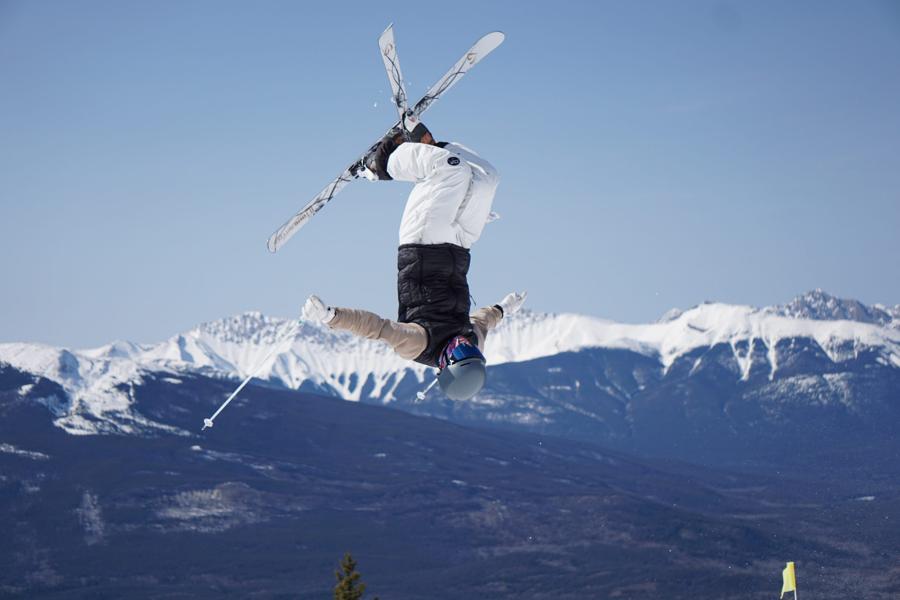
Freestyle skiing, or freeskiing, is a relatively young sport with roots in the 1960s, a time of social change that created a demand for freedom, even in sports. Freestyle skiing was first known as “hot-dogging,” and consisted of combinations of aerial and acrobatic movements to form tricks.
Flash forward to the 1980s: Fédération Internationale de Ski, or the International Ski Federation (FIS), recognized freestyle skiing as a sport. They hosted multiple events, such as aerials and moguls, which were distinct from the prior versions. In aerials, skiers are launched into the air by tall, steep ramps shaped at tight angles to launch the athlete into a flip and/or spin. In moguls, skiers must quickly navigate sharp and frequent bumps, as well as an additional two smaller mandatory aerial jumps in between sections.
At the same time, a new sport was gaining popularity that would alter ski history and culture forever: snowboarding. Snowboards had six main differences from the skis of the time: size, weight, edge sharpness, setup, width, and flexibility. Snowboards were shorter and more nimble than the skis of the time. They were lighter for quick and easy grabs and rotations. They also featured dulled edges that allowed them to slide much better while their broad side faced sideways. They were set up to slide in a different position than skis, with snowboard feet bindings being in a fixed position and the rider’s legs being farther apart. Snowboards were also much wider, giving the rider much more room to grab. Lastly, snowboards could be much more flexible, giving the rider the ability to “butter” by flexing the board to raise the tips/noses (front end of skis or snowboards) or tails (rear end of skis or snowboards) off the ground. These key differences made snowboards a much better choice for anyone looking to try freestyle riding.
The lightweight nature of snowboards enables them to have more mobility for doing tricks like flips, spins, and grabs. This new style did not go long without a name, and was soon dubbed “newschool” riding.
Skiing would take a huge turn from here and change forever. Having seen this evolution in snowboarding, various ski companies created a new version of skis called ski blades. Ski blades were very short, wide, and nimble skis with the same “twin tip” (curved tips and tails) design as snowboards that allowed for backwards, or switch riding. Over the next few years, these twin tip skis would gain popularity around the world and evolve into a more standard ski length, but newschool skiing would dramatically eclipse hot-dogging in popularity.
Five big events would arise out of this more modernized newschool skiing: big air, halfpipe, slopestyle, streetstyle, and knuckle huck. In big air competitions, skiers launch off a ten to 20-foot-high ramp that sends them about 55 to 100 feet high and far, and do a single complex and high-magnitude trick. In halfpipe, athletes launch out of a long downhill ramp in the shape of a pipe cut in half the long way, and perform flips and spins out of it. Slopestyle competitions can vary based on the event, but they mainly consist of three to five rails at the top and three to four big air jumps. Rails are thin tubes, typically suspended from the ground, that skiers and snowboarders slide on sideways. Knuckle huck takes place on a big air course, and has athletes use the steep jump landing to get air time and execute a trick. Knuckle huck is also among the less technical of these disciplines, with stunts being judged based on coolness and its “wow” factor to decide the score, rather than the biggest, most difficult trick winning. Street is by far the most varied and creativity-based, as few large competitions for it exist, and it is almost entirely based on whether a place or object looks skiable, typically off the mountain.
The tricks and terminology of freestyle skiing are also very important components of the sport. Some of the most popular tricks are off-axis rotations, upright spins, flips, and grabs. Off-axis rotations are crosses between flips and spins, and they can be forward, backward, sideways, and any possible direction that is not directly on-axis. Upright rotations are on-axis rotations horizontally around the shoulders. Flips are another variation of on-axis rotation that involves going vertically over the shoulders. Grabs are a different type of trick entirely that does not require rotating at all, but rather reaching down to grab onto the ski or skis necessary to execute that specific grab.
Freestyle skiing has undoubtedly evolved and grown from its roots in the 1960s to the present, more modern newschool versions. Creativity and freedom have drawn in many an athlete, and the element of sheer fun has kept them there. From smooth, calm jumps to precise rails in the street, freestyle skiing may have something for all of those interested.
[Sources: NBC Olympics; Olympics]











Loading Comments...