The Spectacular Finale of a Dying Star
by John Agbo, age 14
In the vast and boundless expanse of the universe, a breathtaking astronomical phenomenon has captivated the human mind since its earliest discovery: the awe-inspiring supernova. A supernova is the spectacular finale of a dying star. When they erupt, supernovas unleash a brilliance so intense that their light can outshine entire galaxies for days, weeks, or even months. These dramatic stellar explosions serve as powerful reminders of the magnificent and unfathomable mysteries that are ever-present in the cosmos.
To fully grasp the explosive nature of supernovas, one must understand the process of a star's death. Several types of massive stars, known as supernova progenitors, can produce supernovas during their final phases. Throughout their lives, these celestial giants simultaneously contend with the relentless pull of gravity and continuously generate heat and pressure from the nuclear fusion occurring in their fiery cores. This delicate balance between gravitational forces and the outward pressure created by the fusion is a crucial aspect of stellar evolution.
As a massive star ages, the processes within its core evolve significantly, depleting its resources. Eventually, a thrilling climax occurs: the once-stable star undergoes rapid compression. As the inward pull of gravity overwhelms the outward pressure, the outer layers of the star collapse inward. This leaves behind a tiny, Earth-sized core known as a white dwarf, which condenses a mass greater than our sun into an astonishingly small volume. The sheer density of a white dwarf is staggering — just a single teaspoon of its material can weigh about 5.5 tons! As the white dwarf cools and solidifies over millions of years, it essentially becomes a diamond in the sky – literally because its core crystallizes to become a diamond. White dwarfs contribute to the cosmic landscape by releasing elements that can form new stars.
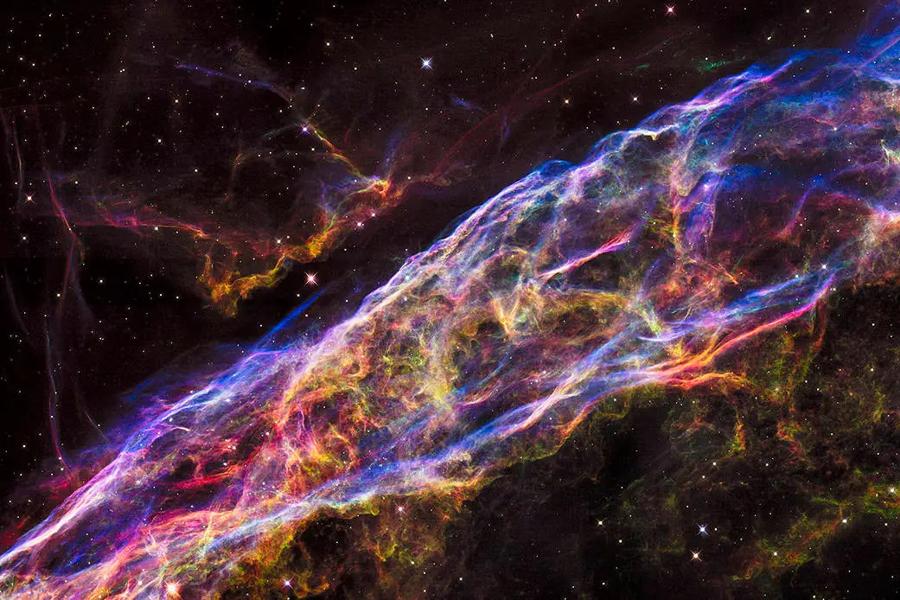
Surrounding the white dwarf lies a beautiful and expanding cloud of hot space dust and gas known as a nebula. These nebulae are a tapestry of colorful clouds made from the remnants of the star, creating stunning cosmic masterpieces that paint the universe in vibrant hues. The remains of a supernova play a critical role in the galactic ecosystem, contributing to the formation of new stars and planets.
However, a star's fate can take an even more dramatic turn depending on its mass. If the core of a massive star becomes increasingly compressed under the overwhelming force of gravity, it can undergo a heart-stopping implosion. This event leads to the formation of a black hole — a region of space where the gravitational pull is so intense that not even light can escape its grasp. Black holes are among the most enigmatic and captivating objects in the universe, stirring our curiosity and challenging our understanding of the laws of physics. They exemplify the beautiful complexity of stellar life cycles, illustrating the dynamic processes that govern the cosmos.
Moreover, our exploration of these astonishing celestial occurrences unveils a stunning truth about the stars themselves: they are abundant in essential elements such as carbon and nitrogen, which are crucial building blocks for life as we know it. The fusion processes occurring within these cosmic giants not only illuminate our night skies but also play a pivotal role in synthesizing the elements necessary for the development and evolution of life throughout the universe. How extraordinary it is to contemplate that the very essence of life may be born in the fiery hearts of stars, intricately connecting us to the cosmos.
[Sources: The Stars; National Aeronautics and Space Administration; Space Center Houston]











Loading Comments...