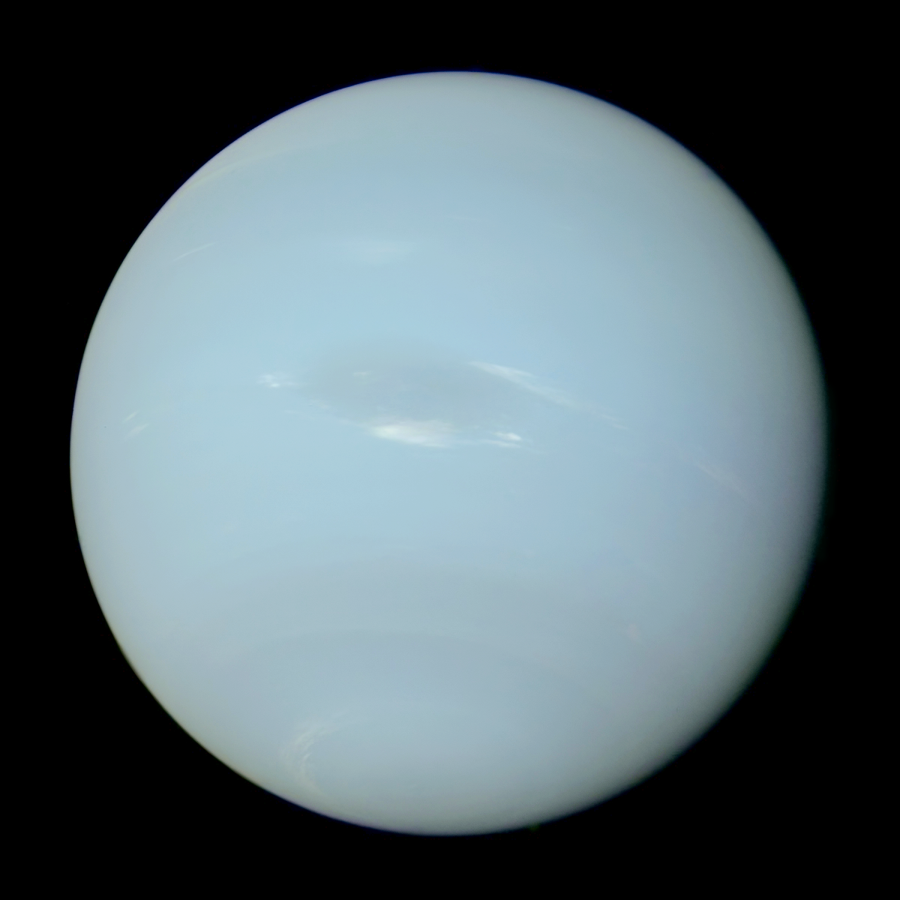
Neptune: Furthest Planet from the Sun
by Aloniab Gezae, age 11
Neptune was the first planet located through mathematical prediction. Neptune, one of our solar system’s two ice giants, has many interesting features, including its location, rings, moons, and climate, which make it unable to sustain life. It is the only planet not visible to the human eye.
Neptune was first discovered as a fixed star around 1612 to 1613 by Galileo, but over 200 years later, Johnathan Gottfried Galle rediscovered it in 1846.
Neptune has five main rings and four ring arcs; the main rings are fully wrapped around Neptune, while the arcs are chunks found in the ring. The first five major rings are Galle, Leverrier, Lassell, Arago, and Adams, which slowly move outwards.
Neptune’s atmosphere consists of helium, hydrogen, and methane. Methane creates frozen clouds that circulate at speeds of 1,200 mph from Neptune’s harsh winds. These winds are three times stronger than ones on Jupiter.
Neptune’s climate is very cold due to its far distance from the Sun – in fact, it is the farthest planet from the sun. However, sometimes, Pluto, a dwarf planet, will take the lead. Pluto and Neptune switch spots for a twenty year period, which is every 248 Earth years. The last switch happened in 1979 to 1999, which means the next switch will happen from 2247 to 2267.
Neptune is an interesting planet of the solar system. It is fun to learn about its climate and patterns to get a better understanding of the planets.
[Sources: NASA; Book of Astronomy and Space]











Loading Comments...