NASA Finds Black Hole Growing Faster Than Expected
by Estefania Garcia-Fox, age 13
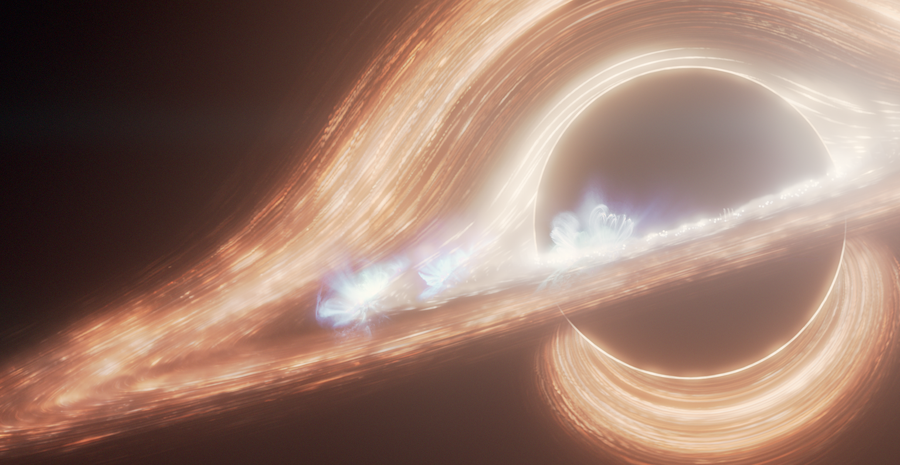
A “rapidly feeding black hole” was found earlier this year by a NASA telescope. This discovery holds many important clues to the evolution of supermassive black holes.
A black hole is an immense object with a gravitation pull so strong that it can pull everything towards it, including light. Supermassive black holes exist at the center of most galaxies, and modern telescopes continue to observe them at surprisingly early times in the universe's evolution.
The newly discovered black hole, LID-568, is pulling at a massive amount, 40 times the limit scientists thought was possible. It was difficult to understand how these black holes were growing massively in a short amount of time. However, the recent discovery of the supermassive black hole consuming matter at an extraordinary rate shortly after the universe's birth has provided astronomers with valuable insight into the mechanisms of rapidly growing black holes in the early universe.
Astronomers could use a special observatory’s unique sensitivity to detect these faint counterpart emissions, which led to the discovery of the black hole. The Chandra X-ray Observatory saw the black hole behind thousands of objects. The speed and size of the outflows led the scientists to infer that a substantial fraction of the mass growth of LID-568 may have occurred in a single episode. LID-568 appeared to be feeding at a rate 40 times its “Eddington limit.” This limit relates to the maximum amount of light the material surrounding the black hole can emit.
The results provide new insights into the formation of supermassive black holes from smaller “black hole seeds” that current theories suggest arise either from the death of the universe's first stars or the collapse of gas clouds. These discoveries suggest that a significant portion of mass growth can occur during just a single episode of rapid feeding whether the black hole is originated by a smaller or large seed.
Black holes remain as one of the most fascinating and mysterious objects in the universe. Scientists continue to study these objects to understand and deepen our knowledge of the universe.
[Sources: NASA, Live Science]











Loading Comments...