Fusion Power Could Shape the Future of Clean Energy
by Will DeFour, age 16
Nuclear fusion has the potential to provide the world with virtually unlimited clean energy. It is the “grand engineering challenge of the twenty-first century,” stated the International Atomic Energy Agency.
Nuclear fusion produces electricity by combining readily available molecules, usually tritium or deuterium, into denser molecules, letting off energy when doing so. This is in contrast to fission energy, which is the same thing that powered the nuclear bomb. Fission energy generates electricity when a neutron strikes a dense nucleus, causing it to split, releasing energy and more neutrons, which in turn trigger a chain reaction. Fission energy accounts for 25% of low-carbon electricity and is key to fighting climate change. However, limited fuel abundance and the threat of a meltdown, like the one at Chernobyl, are forcing specialists to explore other options.
Fusion reactions occur at extremely high temperatures in a state of matter called plasma, or ionized gas. This naturally happens in the sun at 10 million degrees Celsius. The sun's extreme gravity naturally drives fusion, but for the same process to occur on Earth, those molecules would need to reach 270 million degrees Celsius. Although this temperature can be achieved in laboratories, maintaining these temperatures on a global scale requires something much bigger.
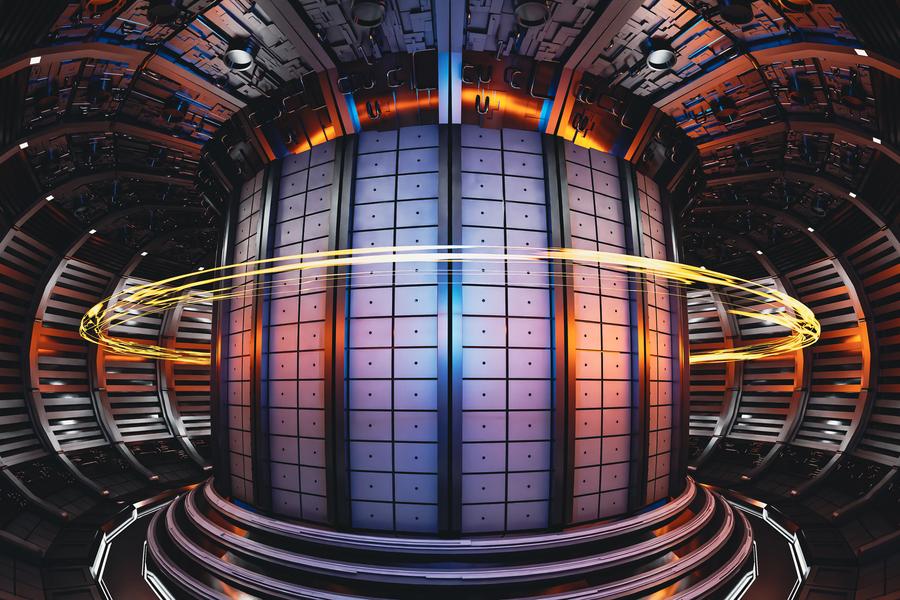
In France, a giant fusion reactor is under construction. The International Thermonuclear Experimental Reactor (ITER) is the largest endeavor in nuclear fusion to date. ITER has a team of over 2,000 workers across a 100-acre site in 90 different countries. Construction began in 2014, though the project has been a concept since the 1980s. ITER is a giant tokamak, which is a donut-shaped fusion generator that forms plasma by ionizing gaseous fuel with electrical currents. Once ITER is fully operational, it will be able to hold six times as much plasma as any modern tokamak. Powerful magnets hold the plasma without cooling it, and they spin it around the donut-shaped chamber. In the ITER system, those magnets must be cooled to just four degrees kelvin, or -269 degrees Celsius, to achieve superconductivity, allowing them to exert stronger magnetic forces for lower energy costs. ITER requires over 10 million pieces that are constructed around the world by member nations of ITER, then transported to the site in France. Each country is making its own contributions: Japan is supplying the heating systems; Russia is building the necessary superconductivity components; and the U.S. is providing the “megamagnet,” which will be placed in the center of the machine.
A global effort toward fusion energy is necessary to achieve unlimited safe energy. Fusion fuel consists of deuterium and tritium, which are hydrogen isotopes. Unlike fission fuels like uranium, which are rare and could run out in the coming centuries, deuterium is common in seawater, and tritium is a potential byproduct of fusion reactions. Secondly, nuclear fusion has immense environmental benefits. Fusion energy produces electricity by boiling water and driving it through turbines. Like fission, it does not produce greenhouse gases. It is also not expected to create long-lasting nuclear waste. Another safety benefit is the impossibility of meltdown. Fusion occurs only under specific conditions, so any system failure will terminate the plasma rather than cause a nuclear meltdown. One last benefit is the energy output. Most renewable energy sources are clean, but not efficient. According to the International Atomic Energy Agency, nuclear fusion does not have the same limitations. “With just a few grams of the reactants, it is possible to produce … approximately the energy one person in a developed country needs for over 60 years.” That is 4 million times the energy output for the equivalent amount of fossil fuels.
Fusion energy has the potential to solve virtually all global energy problems. All it will take is time and research.
[Sources: National Geographic, International Atomic Energy Agency, ITER, MIT News]











Loading Comments...