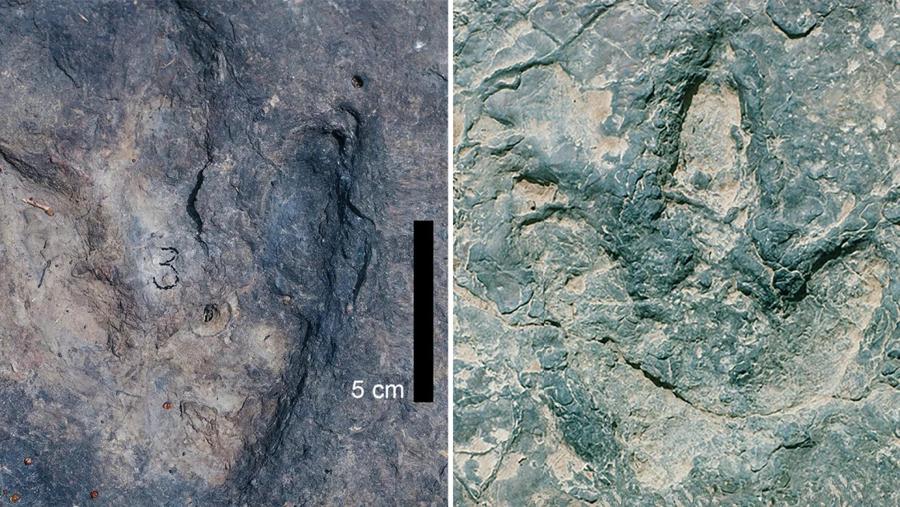
Matching Set of Dinosaur Footprints Discovered in Africa and South America
by Sofia Zapata, age 15
Matching dinosaur footprints found in Africa and South America are helping scientists discover new things about dinosaurs that roamed the Earth 120 million years ago.
Footprints teach us a lot about dinosaurs. Experts see more than just footprints. They infer what the dinosaurs may have looked like, where they were traveling, and with whom they were walking. The footprints they found helped them discover that the dinosaurs were three-toed theropods, four-legged sauropods with long necks and tails, and ornithischians that had a bone structure similar to birds.
An international team of researchers led by Southern Methodist University paleontologist Louis L. Jacobs discovered matching sets of Early Cretaceous dinosaur footprints on what are now two different continents. They found more than 260 dinosaur footprints in Brazil and Cameroon in the late 1980s and some were identical to each other, despite being across the ocean. This led scientists to theorize that dinosaurs lived on land before the supercontinent Pangea broke apart into eleven continents. The footprints were found in mud and silt along ancient rivers that were once located on Gondwana, the southern half of Pangea, that separated because of tectonic plate movement.
Unlike bones, footprints let scientists understand what dinosaurs did. Footprints are direct evidence of how an individual was behaving at a specific moment in time. Fossilized bones are not necessarily found where the animal lived; they could have been washed to a new location, and that is why the footprints are more helpful for scientists. Dinosaur tracks provide a snapshot of when these animals roamed across our planet and how they separated into the continents we know today.
[Sources: CNN; Southern Methodist University]











Loading Comments...