The Blue Glaucus Uses Stolen Venom to Survive
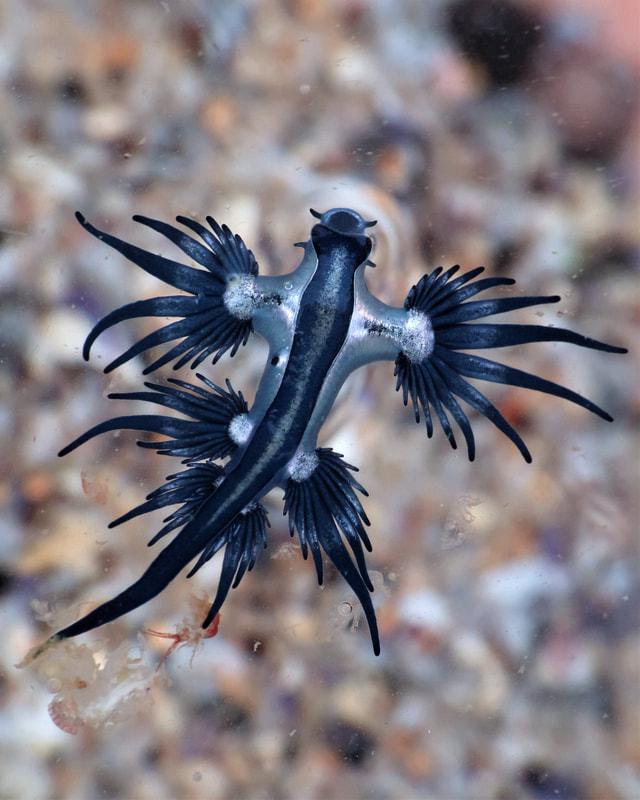
by Siheon Park, age 11
Sea slugs are brightly colored to help them camouflage into their underwater environment and warn other animals to stay away. Their vibrant shades are beautiful – perhaps the most eye-catching is called the blue glaucus, also known as the “sea swallow,” blue angel,” or even “blue dragon.”
Blue glaucuses are found in the Atlantic, Pacific, and Indian oceans. A group of blue glaucuses are called “blue fleets.”
These slugs eat and steal venom from other poisonous animals like Portuguese man wars, by-the-wind sailors, and violet sea snails. The venom is used for hunting and as a defense mechanism. They store the venom and release it out of their “wings” called cerata. This painful venom can travel long distances due to heavy currents, even washing ashore and stinging animals or humans.
Blue glaucuses are hermaphrodites, meaning they have both female and male reproductive organs. They attach their eggs to anything that is near, and after just a few days, larvae hatch.
The population of these slugs is hard to estimate because they are incredibly small creatures in vast oceans. Therefore, scientists do not know if the population is shrinking or growing. They have determined that blue glaucuses are likely affected by climate change because they are now found in new places such as the coast of Taiwan and Texas. This could be due to rising ocean temperatures, storms, or the movement of the prey they feed on.
Even though they are small, these little slugs are still affected by human activity. By reducing climate change, we can still help the blue glaucus.
[Source: Live Science; Ocean Conservancy; Oceana]











Loading Comments...