Was the Trojan War Myth, Legend, or History?
by Ruben Becerril, age 13
Troy was an ancient city as well as an important modern day archaeological site in Turkiyé. It is famous for being the setting of Homer’s poems the “Iliad”and the “Odyssey.”
Troy, in legend, was besieged by the Greeks because Helen, a queen from Sparta was kidnapped by Paris, the son of Troy’s king, Priam. In the “Iliad” the war took place around 1200 B.C. During this time, a Greek civilization the Mycenaean, was collapsing. Their king Agamemnon, led the Greek forces.
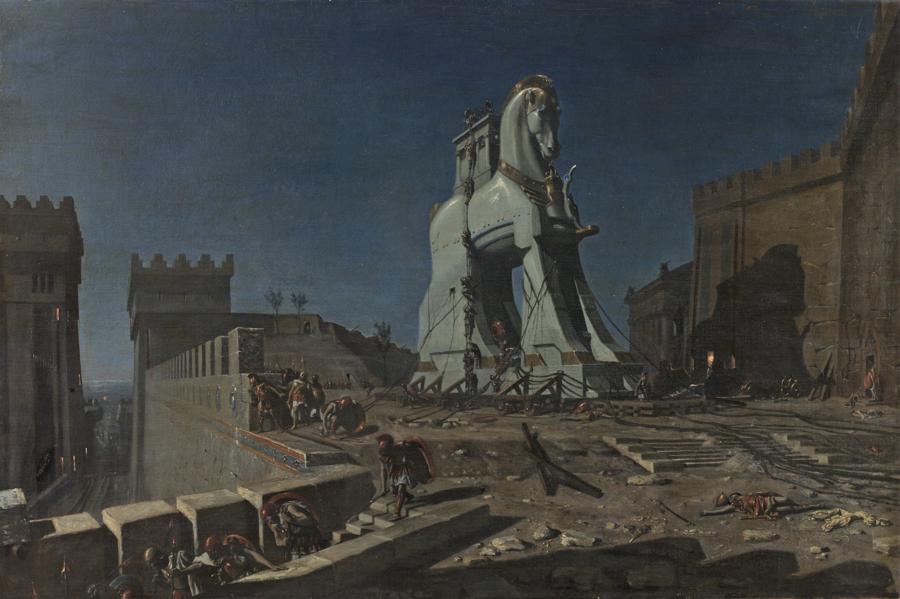
The “Iliad” is set in the final year of fighting over a span of a few weeks. The story shows how the war at this point had practically become a stalemate. The Greeks were unable to take the city and the Trojans were also unable to push the invaders out. While many believe the “Iliad” ends with the destruction of Troy, it actually ends with a temporary truce with fighting continuing after the poem ends. The “Odyssey,” mentions how the Greeks defeated the Trojans using the “Trojan Horse,” a fake gift filled with their invaders who ambushed the city. The Greek army ended the war by destroying the city.
The actual city of Troy has been identified for 4,000 years as Hisarlik, an archaeological site in modern day Turkiyé. The city had different layers from many different time periods. Troy started to develop after 2550 B.C. The city was very modern for the time and had a massive defensive wall made of clay and stone. Archaeologist Van Wijngaarden excavated a layer of Troy in 1873. He discovered treasures consisting of gold, silver, weapons, as well as copper and bronze vessels. He thought all of it was King Priam’s treasure, which was proven false as this treasure existed long before King Priam’s time.
Two other layers of Troy dating between 1700 B.C. and 1190 B.C. are possibly the layers featured in Homer’s works. The walls of these layers were formidable, made of mud-brick breastworks and once reached nine meters tall. The size of the city is disputed because beyond Troy, there was a lower city. However, these layers seem to have been destroyed by an earthquake or an uprising, making it less likely to be the Troy in Homer’s poems.
More archaeological work at Hattuso, the capital of the Hittite Empire, shows that Troy may have never been an independent kingdom. Rather, it may have been a vassal state of the Hittite Empire. However, records do show that there was fighting between Hittite and people from Greece, possibly serving as a baseline for the Trojan War stories.
Was the Trojan War real? While there is some evidence to prove it was, there is not enough evidence to prove it took place. Korfmann, an excavator of Hisarlik, believes the stories had some truth in them. “According to the current state of our knowledge, the story of the Iliad, most likely contains a kernel of historical truth or, a historical substrate,” he wrote.
[Sources: LiveScience; Atlas of World History; National Geographic]











Loading Comments...