The Toledo War Gave Michigan the Upper Peninsula Instead of Wisconsin
by Max Moreno, age 12
The Toledo War was fought between Michigan and Ohio, and is the reason that the Upper Peninsula of Michigan does not belong to Wisconsin.
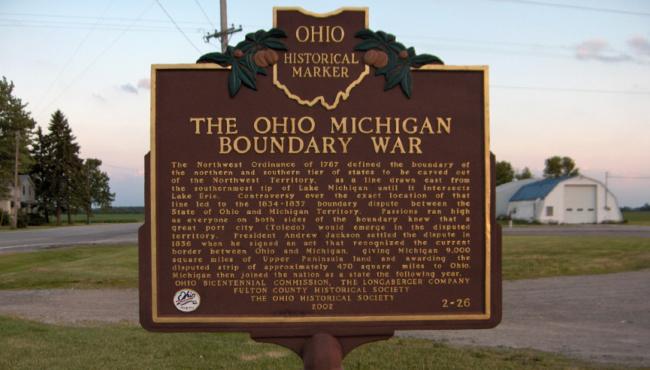
The Toledo War began in 1835 when Ohio and Michigan both claimed a narrow strip of land along their shared border known as the Toledo Strip. Despite being called a "war," the conflict was more of a political dispute than an actual battle.
At the time, Ohio was already a U.S. state, while Michigan was still a territory applying for statehood. The issue stemmed from vague boundary definitions in early legislation and inaccurate maps, which left the border between Ohio and Michigan open to interpretation. Each side moved to enforce its own claim.
In the spring of 1835, a group of Ohio surveyors working in Lenawee County, Michigan Territory, was confronted by about 30 armed Michigan militiamen, including local sheriffs. Nine Ohioans were arrested and charged under the Pains and Penalties Act, a Michigan law that made it illegal for Ohio officials to exercise authority in the disputed area. Those who escaped reported to Ohio Governor Robert Lucas that a sizable armed force was active at the border, escalating tensions and initiating what became known as the Toledo War.
The situation intensified over the summer. On July 15, 1835, a deputy sheriff from Michigan, Joseph Wood, was sent to arrest an Ohioan in Toledo. The man resisted arrest and stabbed Wood with a penknife. Fortunately, the injury was minor, but it was the only bloodshed recorded during the entire conflict.
In response, Michigan dispatched 200 militiamen to Toledo. When they arrived, they discovered that the Ohioans had already retreated. Around the same time, Ohio officials secretly held a court session in Toledo, establishing legal presence in the territory. In retaliation, Michigan's territorial governor, Stevens T. Mason, sent 1,000 armed Michiganders into Toledo, only to find no Ohio officials or soldiers present. The Michigan troops returned home believing they had won.
However, since Ohio had successfully held a court session in the disputed territory, they technically gained the upper hand. To resolve the issue, Congress intervened with a compromise: Ohio would retain the Toledo Strip, and in return, Michigan would receive the Upper Peninsula (U.P.) and be granted statehood.
Michigan initially resisted, believing the U.P. was a poor trade. But eager for statehood and facing federal pressure, Michigan accepted the deal in 1836, officially becoming the 26th state in January 1837.
Meanwhile, in 1836, the Wisconsin Territory was created. Although Wisconsin never formally laid claim to the Upper Peninsula, had the Toledo War not occurred, the U.P. may very well have been included in Wisconsin’s borders due to its proximity and historical association with the Wisconsin region under earlier territorial maps.
[Sources: Michigan Department of Military and Veteran Affairs; Michiganology; VolumeOne; Wisconsin Public Radio]











Loading Comments...