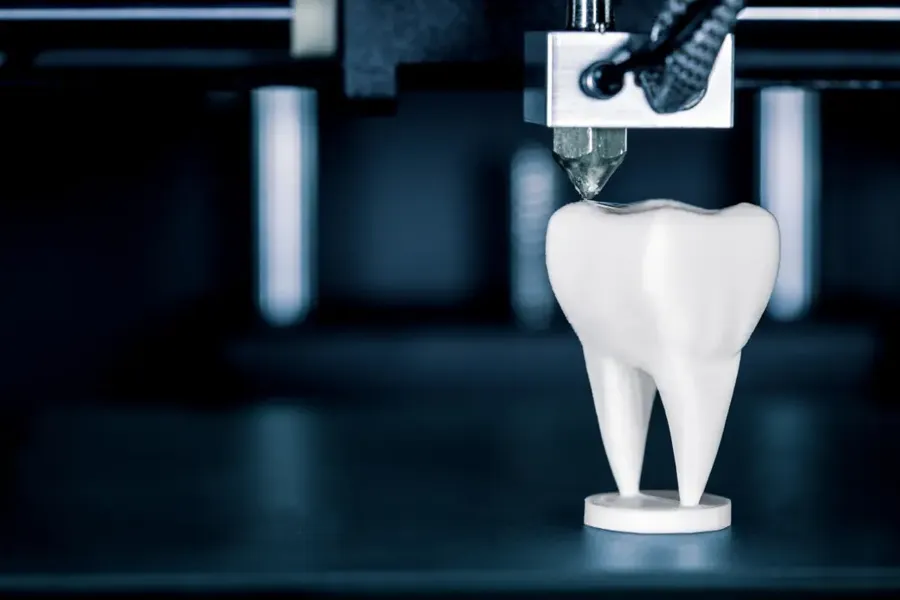
3D Printing Changes the Future of Dentistry
by Dulce Vazquez, age 17
In over 40 years, technology has significantly grown, and new inventions are being made, benefiting healthcare. For example, dentistry is currently in the process of improving because of three dimensional (3D) technology that creates objects in a quick and thorough manner without wasting materials.
3D printing is a technology used across various fields, employing different techniques. It creates a three-dimensional model using a range of materials. The first 3D printer was invented in 1986, by Chuck Hill. Dentistry is now adapting the use of 3D technology allowing patients to receive high-quality experiences.
With the help of 3D printing, dentistry has been able to perform operations in a more precise way with patients’ tissues and bones during implant transfers. With the help of 3D printing, root-shaped implants can bond tightly between the implant and bone and appear more natural. This process is done without multiple surgical tools. 3D printers allow dentists to do crowns, bridges, and other procedures more efficiently. 3D printing reduces pain, discomfort, and bone reabsorption. In addition, fewer materials are used, saving cost and time.
Currently, 3D printing is facing difficulties as it evolves, but it is still having positive impacts. 3D printing dental implants are being developed in clinics that improve the ability to create artificial teeth rapidly. This process is becoming widespread in clinical applications. 3D technology can also predict possible issues that may affect the teeths’ movement.
With the help of 3D technology, there will be more stable and long-term solutions in dentistry. Overall, this technology has helped create personalized solutions and structures for patients, along with oral comfort. As it develops its reliability, it can improve healthcare over time.
[Source: National library of medicine & LuxCreo]











Loading Comments...