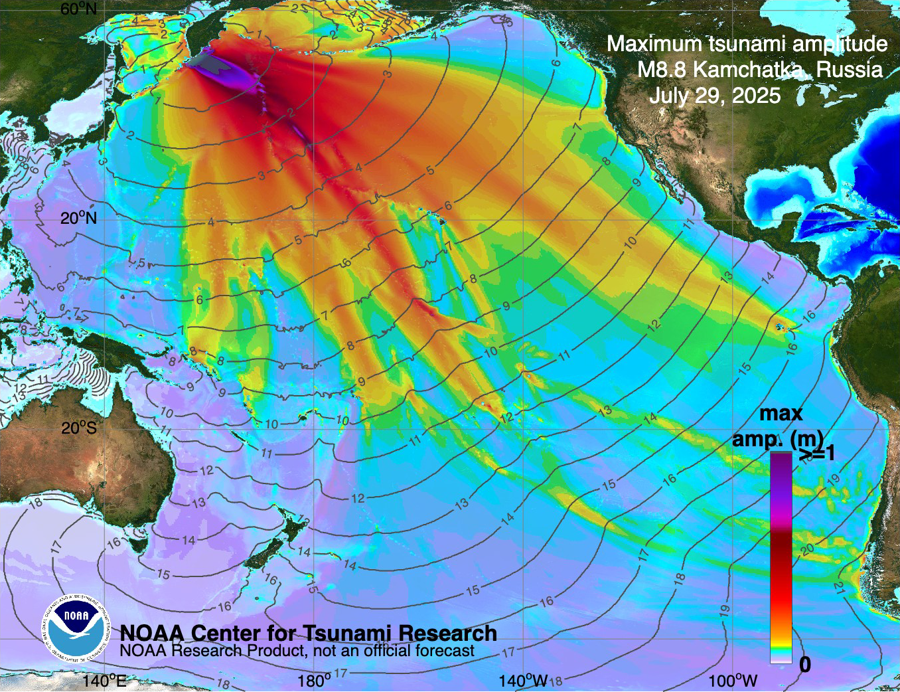
Massive Earthquake Causes Tsunami Across the Pacific Ocean
by Niko Sayu, age 11
On Wednesday, July 30th, an enormous megathrust earthquake located underneath the Pacific Ocean struck off the eastern coast of the Kamchatka Peninsula in the Russian Far East. It was one the largest earthquakes of the past 200 years and Tsunami warnings were raised in many coastal areas.
The strong 8.8 magnitude earthquake caused warnings in multiple nearby countries including Russia and Japan. Several U.S. states including Hawaii, Washington, Oregon, California, and Alaska also issued tsunami warnings.
Then, after many places had lifted their warnings, Chile raised its warnings to the highest level and strongly cautioned residents to stay away from rivers and the Pacific coast. Elsewhere in the Southern Hemisphere, New Zealand was in a similar situation and government officials warned the first waves may not be the largest and to act as if the real threat is still to come.
While the Kamchatka earthquake of 2025 was one of the most powerful on record, the tsunamis it caused did minimal damage. Scientists credit early warning systems for saving many lives.
Josh Green, the governor of Hawaii, said that waves recorded near Midway Atoll, an island located between Japan and Hawaii, reached up to six feet tall from bottom to top.
With tsunamis, as waves travel closer to the shores, it is possible for them to shrink. But a tsunami triggered by an earthquake as strong this year’s can grow as it travels and cause major damage hundreds or thousands of miles away. That’s why warnings went up in Chile and New Zealand just as warnings were ending in places closer to the earthquake.
Green said that a six-foot tsunami wave can flip cars and uproot trees. “The impact is at great speed. Any structure that gets loose and strikes an individual could take them out.” Green said.
Communities along the west coast of North America were on high alert after the recent quake. Crescent City California turned on their sirens and sent out tsunami warnings shortly after the quake happened. The city has experienced extremely damaging tsunamis in the past. In 1964, the community was hit by a 21 foot wave, killing 11 people and destroying the entire downtown.
The powerful 2025 earthquake caused large waves in many places across the Pacific. Because of early warnings and evacuations, damage was light with no reported loss of life. The earthquake did send 13-foot waves into parts of eastern Russia, but no major incidents were reported.
Tsunamis can be very dangerous. They can cause immense damage, and some are deadly. Tsunamis are also unpredictable. They can be triggered by weaker earthquakes that still have devastating results. Tsunamis can also be triggered by powerful quakes that result in little harm and almost no damage, like the recent 8.8 magnitude earthquake in 2025.
But bigger quakes can be really bad. That’s what happened in Lisbon, Portugal in 1755. That tsunami was triggered by an 8.5 magnitude earthquake underneath the Atlantic Ocean. Subsequent tsunamis killed 50,000 people across Spain, Portugal, North Africa, and the Caribbean.
A more recent example was the 9.0 magnitude earthquake that struck off coastlines around the Indian Ocean in 2004. That massive earthquake set off tsunamis that killed more than 250,000 people.
[Sources: Wisconsin State Journal; BBC News; NASA Earth Observatory]











Loading Comments...