How One of South America’s Tallest Mountains Turned Deadly
by Edwin Torres, age 13
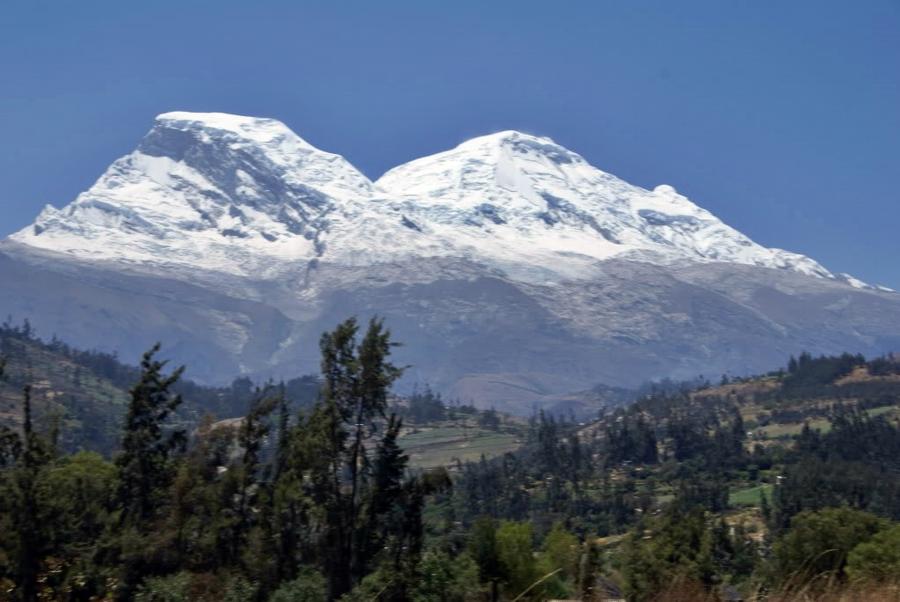
The Cordillera Blanca mountain range in Peru is one of the tallest and largest in the Andes. This region is recognized for its harsh climate and high peaks, including Mount Huascarán.
In the Cordillera Blanca, there are many peaks that rise higher than 19,000 feet. The ice and snow from these frozen mountains flow downhill, carving deep ravines. The region has glacial lakes that support vegetation and create spectacular scenery.
Mount Huascarán is one of the most recognized peaks in the Andes. It is the highest mountain in Peru and the fourth-highest in the Western Hemisphere, standing at approximately 22,205 feet (6,768 meters) above sea level. The peaks in the Cordillera Blanca are considered uninhabitable and dangerous due to extreme freezing temperatures. However, there are thriving villages at lower elevations. Water and fertile soil in these areas support agriculture. The region has been settled for thousands of years, with signs of farming, ancient dams, water canals, and roads left behind by early civilizations.
The snow that covers the mountain peaks feeds local streams and rivers, which flow into valleys on both the eastern and western sides of the Cordillera Blanca. This mountain range has excellent biodiversity, with 112 registered species of birds, including migratory species. A rich variety of plant species also exists in the region.
The Cordillera Blanca is also known for a tragic event that took place on May 31, 1970. On that day, an earthquake off the coast of Peru in the Pacific Ocean triggered a massive avalanche. Rocks, dirt, ice, and snow tumbled down the mountainside toward nearby villages and farmland. The avalanche, which was approximately 3,000 feet wide and over a mile long, swept through the Yungay area at speeds of up to 100 miles per hour.
It destroyed businesses, and the local power company, and uprooted many homes and families. In the town of Ranrahirca, Peru, around 20,000 people lost their lives, with only about 400 survivors. The disaster became known as the Great Peruvian Earthquake or the Ancash Earthquake, and it killed approximately 70,000 people overall, injured more than 150,000, and left around 800,000 homeless. It remains one of the most devastating natural disasters in South American history.
Despite this tragic event, the Cordillera Blanca mountain range and Mount Huascarán remain majestic parts of Peru’s geography, offering beauty, biodiversity, and deep cultural history.
[Sources: BBC News; National Geographic World Atlas]











Loading Comments...