How Do Freshwater Lakes Exist Deep in the Sahara Desert?
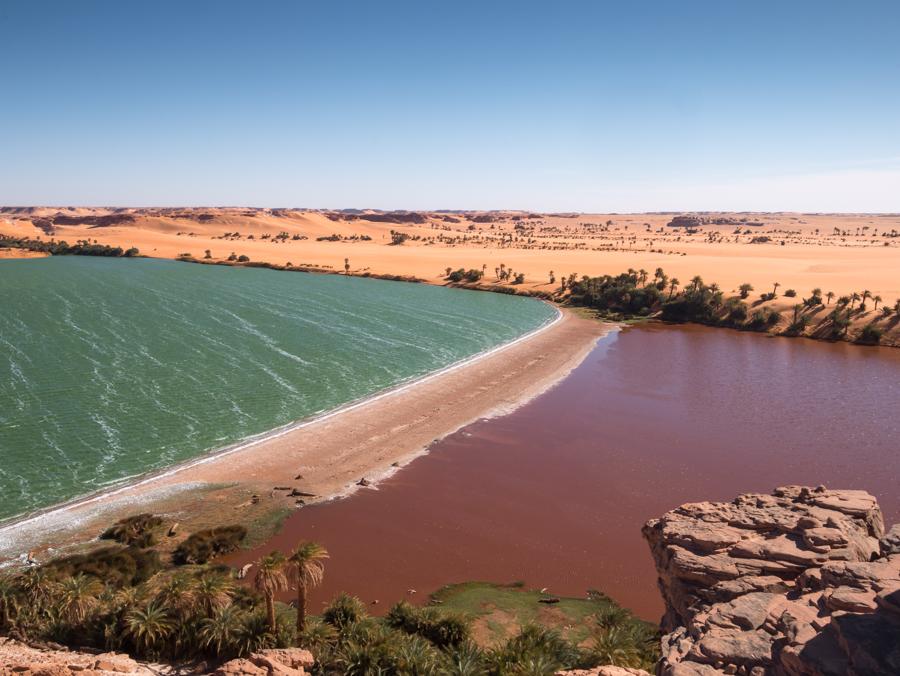
by Oliver Zink, age 13
In the middle of Earth's harshest desert lies a group of freshwater lakes that get their water from a single underground aquifer. These lakes, known as the Lakes of Ounianga, were originally filled with water when the Sahara was a much wetter region. The lakes are located in northeastern Chad, within the Ennedi Plateau region, in a basin near the Tibesti Mountains. The site became a UNESCO World Heritage site in 2012.
According to UNESCO, the lakes are in a scorching and arid desert that receives less than two millimeters, or much less than an inch, of rainfall per year. There are 18 lakes, divided into two groups: Ounianga Kebir (four lakes) and Ounianga Serir (14 lakes). The lakes vary in depth, chemical composition, and coloration.
The climate history of these lakes is connected to human migration that occurred at the end of the most recent ice age, around 11,000 years ago. During that time, large monsoons fed a massive lake, which diminished over time as the desert returned to the area around 5,000 years ago. This process left the lakes of Ounianga with their current size and appearance.
Scientists have been studying these lakes for years to understand how they persist in such an arid environment. As part of their research, scientists have drilled into the lake sediments, reaching the ice-age desert floor beneath. Aerial photographs have also been used to search for evidence of early human settlers around the lakes. Researchers aim to better understand the desertification process that buried the orchards and crops that once sustained human life during the African humid period. During this time, early humans found the area fertile enough to grow crops and domesticate cattle. Rock art in the region supports this evidence.
Many species once lived around the lakes, but as the climate changed, droughts intensified, forcing most species to migrate elsewhere. However, some species have adapted to the unique conditions and continue to inhabit the area.
[Sources: UNESCO World Heritage Center; Times Atlas of World History]











Loading Comments...