Beneath Antarctica’s Ice, Giant Lake Vostok Holds Marine Life
by Dulce Vazquez, age 18
On a world map, Antarctica appears to be a wasteland of snow and ice. But this mysterious southern continent holds some of the most unique geological features on Planet Earth. For example, Lake Vostok is one of the largest freshwater lakes on Earth.
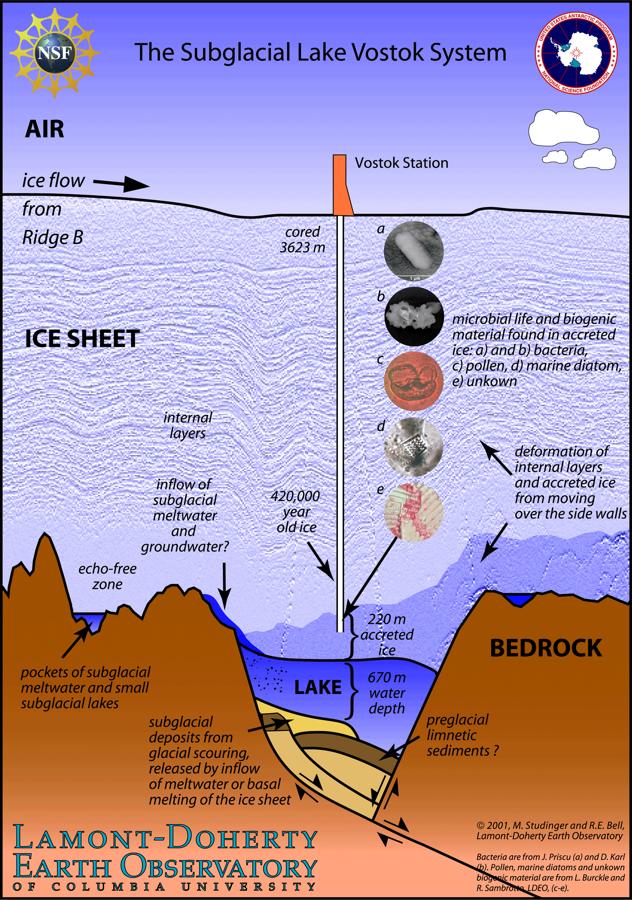
Lake Vostok is just one of the hundreds of subglacial lakes located in Antarctica. Located 2.5 miles (4 kilometers) beneath East Antarctica’s ice, Lake Vostok is approximately 150 miles (240 kilometers) long and 30 miles (50 kilometers) wide. This makes Lake Vostok about the same size as North America’s Lake Ontario.
Marine life in the lake suggests that Lake Vostok may once have been connected to the ocean. Scientists estimate that ice covered Lake Vostok for 15 to 20 million years. Over these millions of years, Lake Vostok developed a unique microbial community. In the 1960s, a Russian geographer and pilot, Andrey Kapitsa, discovered Lake Vostok while observing the surface ice of Antarctica.
No light or air can penetrate the 2.5 miles (4 kilometers) of ice that covers Lake Vostok. Therefore, the lifeforms that have developed are known as extremophiles; these are organisms that live in extreme conditions. These life forms survive by consuming chemicals from the bedrock minerals in water.
Scientists continue to study and learn more about Lake Vostok. This research should help expand our understanding of potential life on Jupiter's ice moon, Europa, or other planets. Researching Lake Vostok may also improve our understanding of astrobiology, the study of the origin of life.
[Source: LiveScience; American Scientist]











Loading Comments...