Australia Is Home to the World’s Deadliest Creatures
by John Agbo, age 14
Though it’s the world's smallest continent, Australia contains more dangerous creatures than any other continent. This island is home to a diverse array of unique and fascinating animals and plants, each with their own level of severe danger and eeriness.
The Stonefish has spines that contain a neurotoxin that will kill you in under 60 minutes. It is found in the Red Sea, French Polynesia, and Queensland, Australia. Their camouflage skills are so good that if they stay still, whether in the sand or a cluster of coral, they are nearly invisible. There are two types of Stonefish, and their eyes easily identify them: the Estuarine Stonefish’s eyes are relatively small and are slightly elevated on their heads within a pit, while the eyes of the Reef Stonefish are on top of their heads. They are known to hide in coral reefs, under rocks, and in the shallows under the sand. If you are not careful, it is very easy to step on one of their 13 highly toxic spines.
The Sydney Funnel-web spider is hailed as the deadliest in the world, with a lethal, toxic bite that will collapse your heart and lungs within 15 minutes. It also has fangs long enough and durable enough to punch through shoe leather. Recently, Australian scientists discovered a new variation of the species, which, at four inches, is twice as big as the original. Scientists named it the Newcastle Funnel-web, nicknamed Big Boy.
The Gympie-Gympie is the most painful plant in the world, and it is located in the Australian rainforest. This plant is covered in needle-like hairs, called trichomes, that, upon contact, will pierce through the skin and inject the victim with a painful but non-lethal neurotoxin, like a hypodermic needle. The neurotoxin is so incredibly painful that one man described it as if he were being covered in hot acid and electrocuted. The neurotoxin turns on your pain receptors and keeps them on. The long duration of pain caused by the Gympie-Gympie is one of the reasons it's so feared. Don’t try to pull out the hairs, as they are made of silicone, which is fragile. Since your body can’t degrade it, your skin just grows over it. Each time the hairs are disturbed, even a little bit, they will release more neurotoxin. They can stay in your skin for years, and this constant, chronic, and agonizing pain has caused some people to go over the edge.
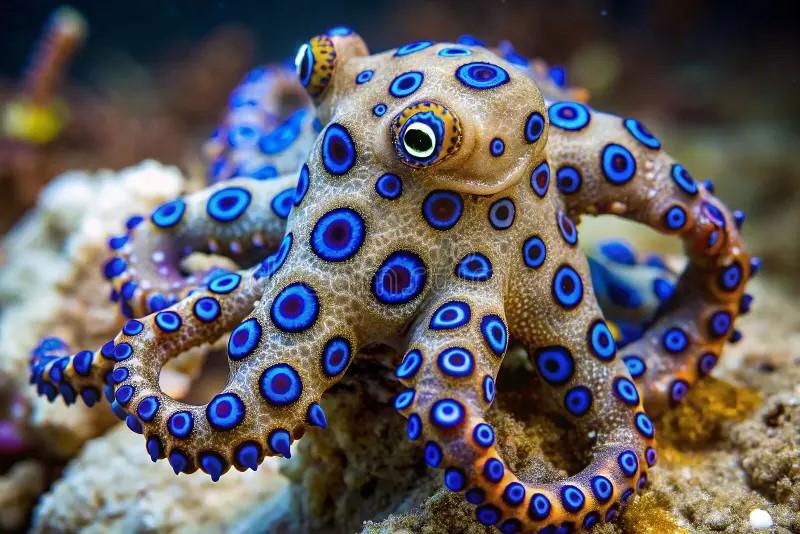
The blue-ringed octopus is known as the deadliest octopus in the world, so it is no surprise that it’s located in Australia. They look mesmerizing with their bright blue rings. Located in southern Australian waters, they behave like any normal octopus except their saliva glands harbor numerous bacteria that produce a chemical called tetrodotoxin. When stung, the tetrodotoxin blocks sodium channels throughout the body, which are essential for nerve transmission. Blocking these nerve signals can lead to muscle paralysis and a complete failure of important actions such as breathing. The worst part is that its victims remain completely conscious and aware they are drowning, and being eaten alive.
The Cassowary, also known as the most dangerous bird in the world, is capable of delivering a kick to the gut with the five-inch claws attached to its raptor-like feet. There are three species of Cassowary, one of which is the Southern Cassowary. This species is located in both northern Queensland and southern New Guinea, and it is defined by its double wattle. The cassowaries of the north, which are located in northern New Guinea, are known for their single wattle. Dwarf Cassowaries, which are found in central New Guinea, are the smallest and are known for having no wattle at all. Southern Cassowaries grow up to six feet tall, and the females are typically larger than their males. Female Cassowaries weigh around 170 pounds and are more brightly colored than the males, which weigh about 120 pounds on average.
The Inland Taipan is the deadliest snake in the world, and depending on many factors, it can kill a person in between 15 and 40 minutes. Located in the Australian outback, the snake ranges from 5.9 to 8.2 feet, with fangs about a quarter of an inch long, which is relatively short for a venomous snake. While its fangs are small, its venom packs the smallest lethal dosage of any snake. A single bite can theoretically kill 250,000 mice.
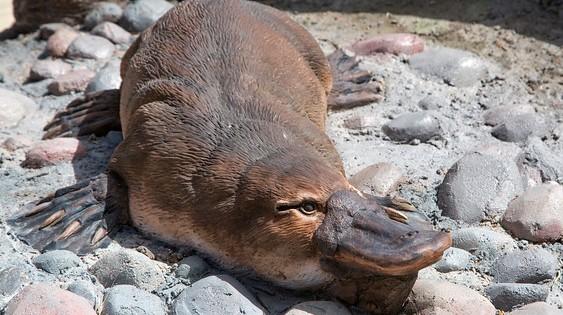
The Platypus is easily among the weirdest creatures ever discovered. They are one of two mammals to be oviparous, meaning they lay eggs. They also secrete milk and are among the few mammals to be venomous. The males possess a horned spur on their hind legs, which is connected to a venom gland in their legs. The venom is not fatal but can cause intense and excruciating pain for weeks that is resistant to strong painkillers like morphine. Because the venom is so unique, there is no known antivenom. Males usually grow from 15.7 to 24.8 inches, while females grow from 14.6 to 21.6 inches. They are semi-aquatic mammals with a streamlined body covered in waterproof fur and a broad paddle-like tail used to store fat. They have front-webbed feet and hind legs with semi-webbed back legs, serving as propellers and rudders, respectively. When they were first discovered, researchers had tried to take the bill off because they thought it was sewn on; the Platypus is so disproportionate that people refused to believe they were real for a time. Their bills have electro-sensory capabilities, which is what sharks use to hunt. They dive into the water blind and use their bill to detect electromagnetic fields in the water. They also glow green under ultraviolet light, which means the color of Perry the Platypus was technically accurate!
Australia is a great place to visit year-round if you enjoy the heat and the pleasant climate. While the deadliest of creatures reside on the small continent, one thing most of these animals have in common is a healthy fear of humans. The likelihood of finding one of these creatures is very low, and very few people have died from an encounter.
[Sources: Australian Institute of Marine Science; Australian Museum; Australian Geographic; Natural History Museum; Healthdirect]











Loading Comments...