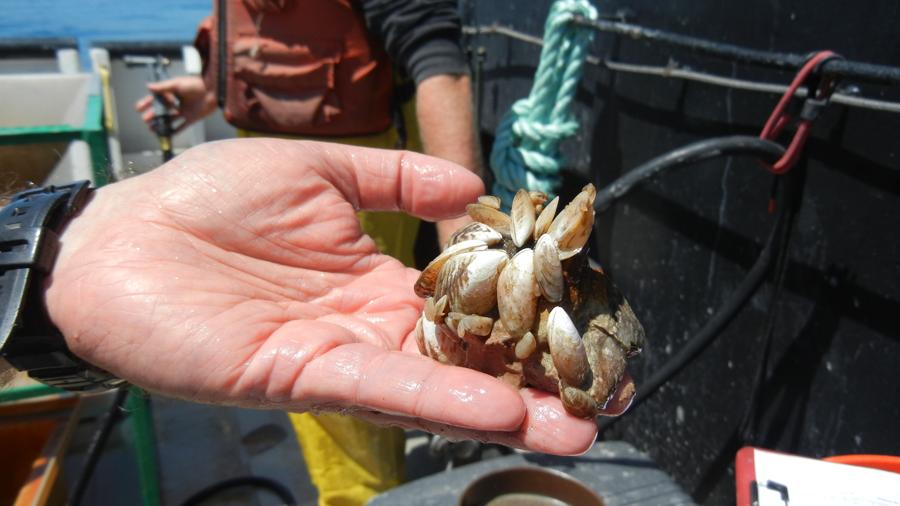
Invasive Mussels Threaten Lake Ecosystems
by Will DeFour, age 15
A close relative of the highly invasive zebra mussel, known as the quagga mussel, has spread across the Great Lakes, removed valuable nutrients from the water, and even begun moving into smaller lakes across Wisconsin.
The quagga mussel was discovered in 1897 but was ignored for decades until it entered the Great Lakes in 1989. Quaggas can live deeper below water than zebra mussels — up to 130 meters below surface. They can also survive greater temperature extremes and, most alarmingly, can grow and thrive on soft surfaces on the lakebed. Zebra mussels can only grow on piers, rocks, and other hard surfaces. Lakes have few hard surfaces and are mostly covered by soft bottoms. Lake Mendota, for example, is 95% soft bottom. That’s what stopped zebra mussels from destroying the Yahara lakes. However, quaggas dont have the same limits.
Quagga mussels harm lake ecosystems by filtering nutrients that fish and other crustaceans need to survive. The mussels also take in pollutants that are dumped into the lake, and quagga predators are harmed by those chemicals. Lake Erie’s dead zone may be the result of this endless filtration. These mussels harm more than their surrounding environment; quaggas can also build up on piers, beaches, and boats. These mussels also clog pipelines and water treatment plants, which cost millions of dollars to fix annually.
Boaters are the main way that quaggas spread to different lakes. Their eggs hatch into small larvae that float across the lake surface and attach to boat hulls, where they can't be spotted by the human eye. If the boat isn't dried or cleaned before it enters new waters, the quagga mussels can spread to a new lake. The spread can be prevented by spraying the boat hull with hot water, or drying the boat for five days.
In 1991, zebra mussels began to spread beyond the Great Lakes; quagga mussels followed close behind. After a year the quaggas reached the Gulf Coast, and by 2008 they made their way to California. In Washington, conservation officials trained a dog to find quagga larvae that ship inspectors missed twice. These efforts have all been combined to slow the spread, yet none have fully stopped it.
Ecosystems across the states have been adapting to the new threat in different ways. In the Great Lakes, lake sturgeon have started eating quaggas, which has boosted the survival of this vulnerable species. In the Houston River, hundreds of blue crabs move upstream to feast on the mussels each summer, causing only one in 100 zebra mussels to survive more than a year. On the flip side, roughly 1 billion native pearly mussels have disappeared due to the Quagga invasion.
Scientists across the states are trying to combat the mussel threat and rebuild native species. They have bred white fish in a pond, rebuilt reefs where native fish spawn, and even tried to engineer a contagious blood cancer to stop the invading mussels.
The push against zebra mussels has been astoundingly effective, and now the same must be done to stop quagga mussels before it's too late.
[Source: Wisconsin Public Radio]











Loading Comments...