The Aral Sea Is Disappearing Before Our Eyes
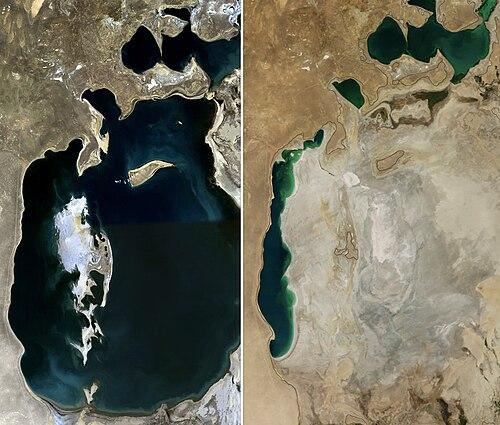
by Will DeFour, age 16
Conservation efforts in Kazakhstan continue to protect the remnants of what was once the world's fourth-largest lake, the Aral Sea.
At its prime, this sea lay between the two Asian countries of Kazakhstan and Uzbekistan. In the second half of the twentieth century, the Soviet Union sought to irrigate large plots of desert to grow cash crops such as cotton. These projects diverted water from rivers throughout central Asia. The largest canal constructed was the Karakum Canal. It drew on water from the Amudara River, a major tributary of the Aral Sea. The canal stretched over 800 miles and lost much of its water to evaporation and seepage into the ground. As these canals were constructed, the Aral began to shrink. Despite covering 26,000 square miles, it was a shallow lake with an average depth of 53 feet in 1960. By the turn of the century, satellite imagery showed the once-great lake splitting into three parts—the small Aral Sea to the north and two lobes, east and west. The far shallower eastern lobe disappeared completely in 2014, becoming the Aralkum Desert.
The desertification of the Aral Sea left devastating impacts not only on the environment but also on the people living there. Fishing towns that once sat on the shores of the Aral lost their source of trade and food.
In an article for New Line Magazine, Diana Cruzman recounts her visit to Aralsk, a once great port town of 36,000 people. “The town's wide streets are adorned with murals depicting a bygone era: azure waves, seagulls, boats perched above curious fish. Lonely cranes hover over a bay that hasn't seen water in over 40 years, waiting to unload cargo from ships that will never come.”
What was once the world's fourth-largest lake has shrunk by 90%. Left in its place is the Aralkum Desert, known for its dystopian imagery of huge, rusting metal ships, abandoned miles from any water. The Aralkum constantly blows salt, dust, and farming chemicals from the lake that once sat in its place over nearby cities and farms. The dust ruins farm soil and causes many health problems in the cities, including difficulty breathing and, in the long term, cancer. Some of the dust from the Aralkum Desert can reach as far as the Scandinavian Peninsula. The loss of the Aral Sea has created a drier environment and more extreme temperatures in summer and winter. In the words of Ban Ki-moon, the former Secretary-General of the United Nations, the destruction of the Aral Sea is “One of the worst environmental disasters of the world.”
Despite the devastation in and around the Aralkum Desert, a remnant of the former great sea remains. The northern Aral Sea has benefited from conservation efforts, such as dams and canals, that protect the northern Aral while allowing other parts of the sea to continue desertifying. In 2005, the International Fund for Saving the Aral Sea completed the Kok-Aral dam. Once construction on the eight-mile concrete border was completed, the volume of the Northern Aral Sea rose by 42%. The Kok-Aral dam allowed fish to re-enter the basin and lowered the general saltiness of the remaining sea. Kazakhstan's government intends to build upon the dam and eventually restore the sea all the way back to the city of Aralsk. In the disastrous Aralkum Desert, deep-rooted trees that thrive in salty, dry conditions, called saxaul trees, can help stabilize the apocalyptic environment and prevent further dust storms. Kazakhstan and Uzbekistan have collectively planted over five million acres of these trees in less devastated parts of the Aralkum. Tragically, these trees are nowhere near a perfect solution. The desert is still inhospitable, with conditions rarely suitable for vegetation. Under 15% of all saxaul trees survive for extended periods, highlighting the desert's dystopia and the imperfections of this solution.
Other lakes around the world are shrinking, such as the Dead Sea, Lake Chad, and the Great Salt Lake. The destruction of the Aral Sea should serve as a lesson in how devastating environmental changes can truly be.
[Sources: National Aeronautics and Space Administration; New Line Magazine; The Astana Times]











Loading Comments...