New CTM Play Lets Young People Address Climate Change

by Haliah Berkowitz, age 14
The latest production from Children's Theater of Madison’s addresses the implications and potential consequences of what many call one of the most pressing topics of our time: climate change. Directed by Marcella Kearns, “The Trials” runs through May 11 in the Starlight Theater at MYArts.
This play falls perfectly within CTM’s mission for their current season, “having something to say.” The youth are center stage, with freedom to express their concerns about the future, while embodying and playing characters who live with the consequences of society’s current actions.
“The Trials” was written in 2022 by Dawn King, a British author and playwright. CTM’s performances mark the third time this play has been showcased in the United States.
“The Trials” is a fictional stage production rooted in a non-fictional reality. It is set in an unspecified year in the future; however, the dystopian play is not meant to have a futuristic tone, since the hypothetical events of the story could theoretically take place much sooner than we think. Director Marcella Kearns described the play as a “really exciting, yet cautionary tale.”
Brian Cowing, the artistic director for CTM, told The Capital Times, “It is a gripping near-future courtroom drama that places the fate of adults who contributed to the climate crisis in the hands of young people.”
The play opens to an audio of a pounding heartbeat. One spotlight emerges from the dark onto a middle-aged man, played by Trevin Gay. He pleads his case, attempting to justify why his actions–flying overseas, driving two cars, and eating meat–did not make him guilty. The audience leans in as this defendant explains that he didn’t know any better, he was only doing what he needed to for his family. Then, the alarm sounds. Time is up.
The set transforms into a jury deliberation room. Twelve people–children–walk in. These are the jurors, twelve youth between the ages of 12-17 randomly picked for jury duty. One child comes in coughing, clutching an inhaler. Others fan themselves due to the inescapable heat. Several jurors wear rubber boots, most wearing clothing fit for manual labor.
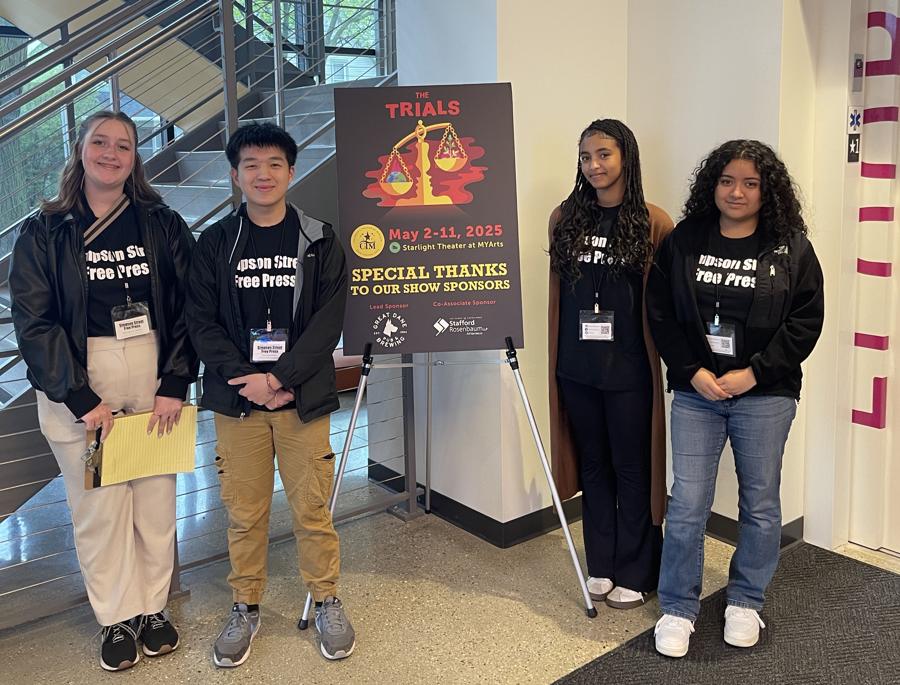
In a brief conversation with Simpson Street reporters after the show, Kearns highlighted the creativity of costume designer Jeannette Christensen, who manifested a slightly futuristic atmosphere by bringing upcycled and utilitarian styles to life. Kearns noted the delicate balance of making the costumes futuristic while maintaining a natural and realistic feeling.
The jury has only 15 minutes to reach a majority decision about whether the defendant is innocent or guilty. If found guilty, the defendant is put to death. This verdict must be reached through a discussion about whether a defendant did all they could to help save planet Earth, taking into consideration factors like their socioeconomic status, their carbon footprint, and their lifestyle.
But as the synopsis provided on the CTM website prompts audiences to ask, “are they delivering justice – or just taking revenge?”
Each juror displays a different array of emotions. While some cannot handle the thought that their actions could directly affect the course of someone else's life, others are angry and resentful, arguing each defendant is guilty. Others remain undecided. Some are too young to understand the gravity of their circumstances, leaving the older jurors to simultaneously educate and protect the younger ones, without influencing their votes on defendants’ innocence or guilt.
Director Marcella Kearns explains the play is “exploring what would happen if adults, those of us living now, end up going on trial for not having done enough to stop catastrophic climate change. The jury [is made up of] teenagers, those who are most affected by the action we are taking now.”
Throughout the play, it is obvious that this jury duty is not relished by all jurors. Several express their underqualification to make such decisions, and that professional scientists and adults are needed in the world for their experience and expertise. The responsibility of making verdicts in the play parallels the responsibility and pressure society puts on youth regarding climate change.
It is true, the young people of today are the leaders and problem-solvers of tomorrow. Ultimately, current and future generations of young people will be tasked with righting the wrongs of previous generations, if they can. But, as this play so aptly explores, should the responsibility of doling out justice and making things right really be placed on children?
CTM’s young cast emphasizes the play’s message through their riveting and eerily realistic telling of the story. As Cowing told The Capital Times, “A lot of times, shows rely on adults to lead things, pop in, and keep the energy going. These are our young cast members driving the show, being the stars of the show.” The actors give “The Trials” a refreshing shift that puts the spotlight squarely on the next generation of actors and performers. Their energy and dedication bring a unique authenticity to the stage that’s hard to overlook.
During a post-show talk-back with the actors, they were asked what they think audiences should take away from watching this play. In response, Zoë Littlefield, who plays Kit, said, “I think the audience should think about the fact that this is real and happening now, and that we have to do whatever we can to protect our planet because it's the only one we get.”
Dexter Nardi, playing Xander, also weighed in by replying, “This is important, and real, and needs to be talked about.” The young actors’ responses highlighted that young people are keenly aware of the urgency of the climate crisis and motivated to action.
The actors were also asked if this play has pushed any of them to make changes in their own lives. Bekah Cooper, who played Mirari, said they started using metal water bottles and reusable bags when shopping, and several said they have changed their eating habits and cut back on certain red meats.
“The Trials,” put on by Children's Theater of Madison, immerses the audience in this potential near future, where open windows are not allowed, nearly everyone carries an inhaler, and enmity runs wild between the older and younger generations. The dialogue seamlessly shifts between funny, to unsettling, to moving, leaving audience members stunned with the seriousness and insight of the young performers. While the play is not inherently hopeful, it forces us to reflect on our actions, leaving everyone with a renewed sense of motivation and faith in humanity’s ability to do the right thing.
As was said on stage, “We have to start treating the Earth as the most valuable resource we have.”











Loading Comments...