.jpeg)
Exhibit Review: "Echoes from the Arc"
by Iliyan Hoskins, age 12
Simpson Street Free Press recently visited the James Watrous Gallery, located inside the Overture Center, to view an exhibit titled “Echoes from the Arc.” This exhibit featured artwork by local artist Jerry Butler, who uses his art to depict individuals who have shaped African-American history and to inspire all of us to help create a more just society.
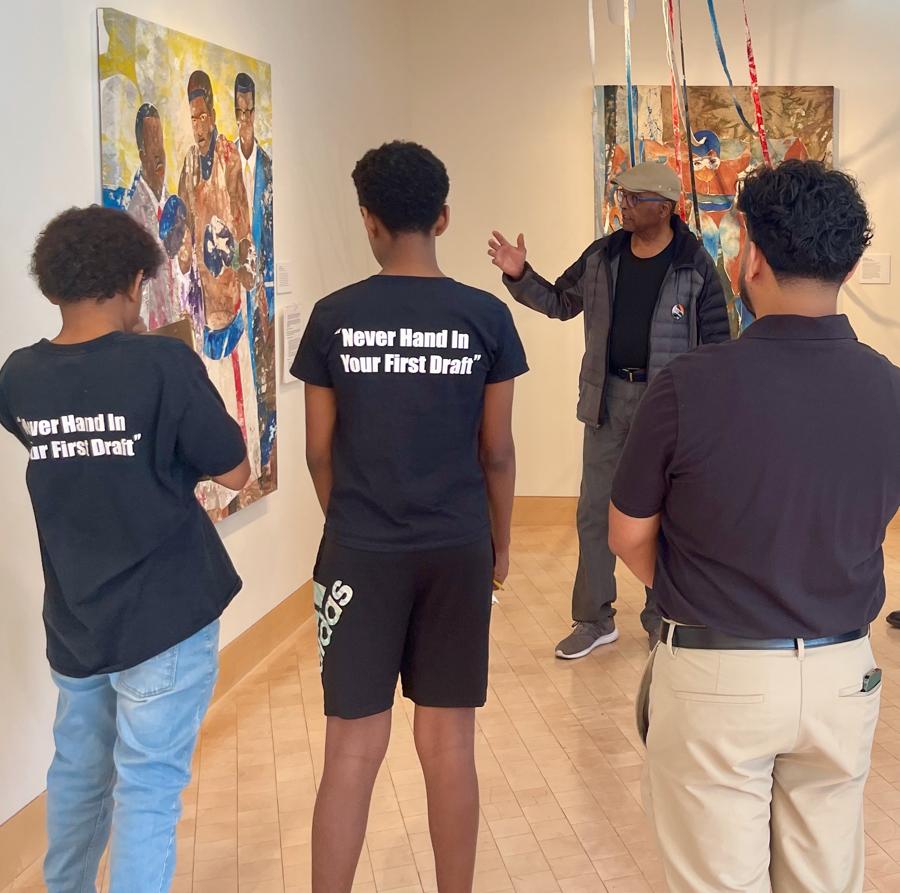
We were welcomed by Jennifer Graham, the exhibition and outreach coordinator at the James Watrous Gallery. During our visit, we got to meet Butler personally, and he taught us about the historical figures and events portrayed in his works and what inspired him. Butler writes: “The purpose of my exploration is to emphasize the creativity that emerges in the center of a world of disenfranchisement.”
Jerry Butler was born in Mississippi in 1947, and was the oldest of nine siblings. He started college at the age of 16 and graduated at 19. “Through all of that,” he said, “I could not write. In reading, I was barely competent.”
Nevertheless, he earned a degree from Jackson State University in Art Education, after which he began teaching middle school art classes in Madison, Wisconsin. Butler continued his studies at the University of Wisconsin-Madison, earning a couple more master’s degrees and a doctorate. He taught at the Madison Metropolitan School District for over a decade and also has served as Associate Dean at Madison College. His art can be found around the country, which reflects many of his experiences and the struggles he faced.
“Sometimes creativity comes as a result of stress and hardship,” he explained to us. “Like me, I have to create; if I don’t, I don’t know what I’ll do.”
.jpeg)
He talked us through his unique artistic process as well. The distinctive way he uses materials and textures to create collages that are partly realistic and yet also abstract reflects his statement: “Design is the fabric of sustainability.” He traced his fingers along the fabric of his piece titled “Resistance“ and explained, “I had to create this material, what I do is crinkle it all up and put paint on it, and if that’s not good enough, I crinkle it up again and put more paint on it.”
When we walked in, we immediately saw a tall pillar of various hues of painted fabric entangled and woven together, which we later learned was his representation of the Arc, which he refers to in the exhibit title, “Echoes from the Arc.” With the whole exhibit, Butler is alluding to a quote from Martin Luther King Jr.: “The moral Arc of the universe always bends towards justice.” Congresswoman Shontel Brown of Ohio added on, saying, “It does not bend toward justice on its own.” The individuals Butler portrayed in the pieces on display are all “arc benders,” according to Butler, whose courageous actions and existence helped pull the arc of the universe closer to justice.
Throughout our visit, Butler drew us in close to the artwork, showing us how he uses “color in an academic way” and uses “lots of darks and lights to create drama.” The layering of different vibrantly colored pieces of fabric creates contrast and texture. He also pointed out that in his artwork, he has letters and words semi-hidden on the canvas, highlighting the messages he hopes to convey through his artwork.
One unique piece that stood out in the exhibit is called “King, Ali, & X.” These important figures during the Civil Rights Movement all had their own way of working for racial justice. Though they didn’t work together much, their efforts reflected that they shared the same hopes for the future of Black people in the United States, with equality and justice. Butler’s art positioned Muhammad Ali in a fighting stance in front of both Dr. King and Malcolm X. An intriguing feature of this piece – and most of the other pieces in the exhibit – was that the people had very few facial features or none at all. For example, in “King, Ali, & X,” only Muhammad Ali had eyes. Even so, the figures are very easily recognizable, highlighting Butler’s skill.
Another piece that caught our eye was “Harriet.” It showed Harriet Tubman, who was born into slavery in 1822 in Maryland, wearing all white and holding a lantern above her head. The light from the lantern shines brightly in all directions, providing a guiding light through the woods for her and the people she was leading to freedom. Again, no one in the image had faces. The artwork captured an iconic moment in Tubman’s life and African American history, full of hope and resilience.
As we neared the end of our tour, one Simpson Street reporter asked Butler what he hoped people would take from his artwork, and he responded simply by saying: “Be good.”
Butler segued into sharing with us some pieces of advice. He expressed, “When I look at young people, I hope that you will be critical, learn to think, organize, and design your own life for yourself.” He encouraged us to absorb as much learning as possible, and to take all that learning and put it to good use, since “Awareness is the path to freedom.” He pointed to the figures and individuals in his artwork around us, referencing their actions as he said, “Unless we can solve problems as human beings, we will certainly perish.”
The exhibit “Echoes from the Arc” celebrates the courage and resilience of individuals, both famous and not, who impacted the course of history. The moving and thought-provoking artwork will be on view until July 13th at the James Watrous Gallery. The gallery is free for the public and is open Thursdays-Sundays from 12:00-5:00 pm.











Loading Comments...