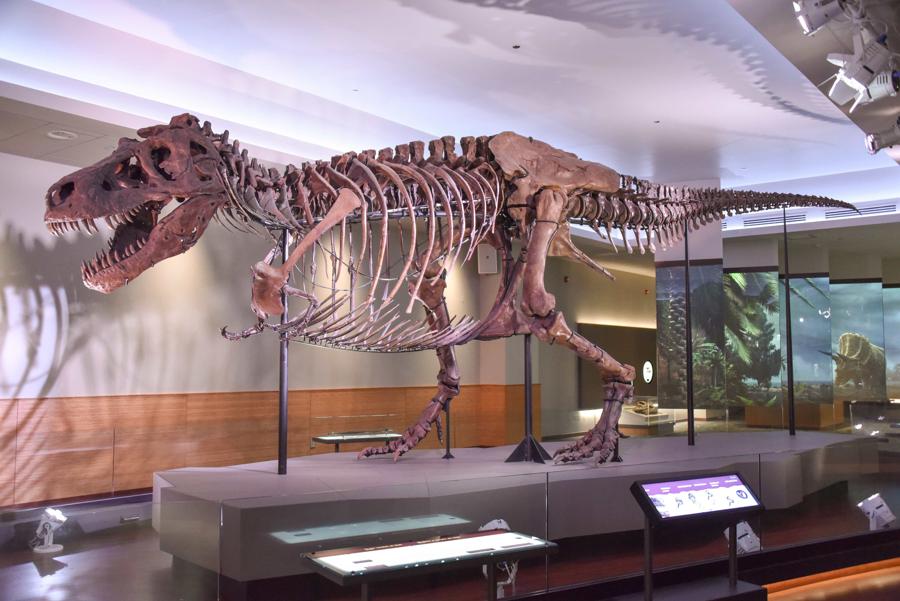
A New Look at the Tyrannosaurus Rex
by Edwin Torres, age 14
Recent scientific research has reimagined the appearance of the Tyrannosaurus rex (T. rex), moving away from the classic scaly, snarl-toothed image.
New findings suggest that the T. rex likely possessed soft, fleshy lips that covered rather than exposed its crocodile-like teeth. Other studies had suggested a feathered appearance, depicting it with a coat of feathers.
Scientists are also re-examining the giant footprints made by this dinosaur. An analysis of fossilized tracks and the tyrannosaurus rex’s lower-leg anatomy is being used to reconstruct the dinosaur’s gait. The findings show the top of the dinosaur food chain walked on its tippy toes, similar to present-day birds.
Steve Brusatte, a paleontologist at the University of Edinburgh, who was not involved in the study said, “It would have been something like an eight-ton chicken clucking about in the barnyard.”
Adrian Boeye, an undergraduate student at the College of the Atlantic in Maine who studies biomechanics, led the project. Adrian was curious about how the T. rex, an animal that can weigh over ten tons, was able to move through its environment and chase down its prey.
As Boeye stated, past attempts to reconstruct T. rex's movements usually simplified the dinosaur’s feet. He stated, “The feet were treated as these rigid blocks that would simply stomp on the ground heel-first.”
The T. rex’s movement mechanics varied from those of its living relatives, for example, terrestrial birds, who land on the surface with their front feet first. These birds use short, fast strides to sprint, reducing contact with the ground and allowing a smoother, more stable transition from walking to running. Bigger birds use these short strides to reach their highest speeds, like an ostrich, which can reach 43 mph, far faster than other bipedal runners such as humans.
To figure out whether a larger animal like the T. rex moved like present-day birds, Boeye and his peers studied the dimensions of fossilized footprints left by T. rexes in New Mexico. They examined the lower-leg structure of many skeletons, including a young T. rex and a fully grown behemoth called Sue. To calibrate their models, researchers accounted for the muscular tail by analyzing how present-day birds move.
This data helped calculate the dinosaur’s stride frequency, speed, and foot-strike patterns, which revealed what part of the foot made initial contact with the ground. This information showed that T. rexes most likely hit the ground toe-first, as modern birds do, and used quick, short steps to reach maximum speeds. Boeye stated, “Rather than taking these bigger steps, like in Jurassic Park, it moves quickly by rapidly swinging its legs. It would resemble being chased by an oversized bird.”
The biomechanical models reveal that the T. rex speed varied with their size. Younger T. rexes likely moved at over 37 feet per second. Larger adults, such as Sue the behemoth, reached speeds of around 20 feet per second, similar to a modern Komodo dragon. This difference in pace suggests that the T. rex hunted different prey as they got older.
According to Thomas Carr, a paleontologist at Carthage College who was not involved with the study, the results offer insights into T. rex lifestyle that can not be inferred from fossilized bones alone. New findings also point out how closely related Tyrannosaurs are to present-day birds.
Adrian Boeye and his peers would not be surprised if older theropod dinosaurs walked on their tippy toes before T. rex appeared.
[Source: New York Times]











Loading Comments...