It Looks Like a Jellyfish, but it's Actually a Group of Zooids
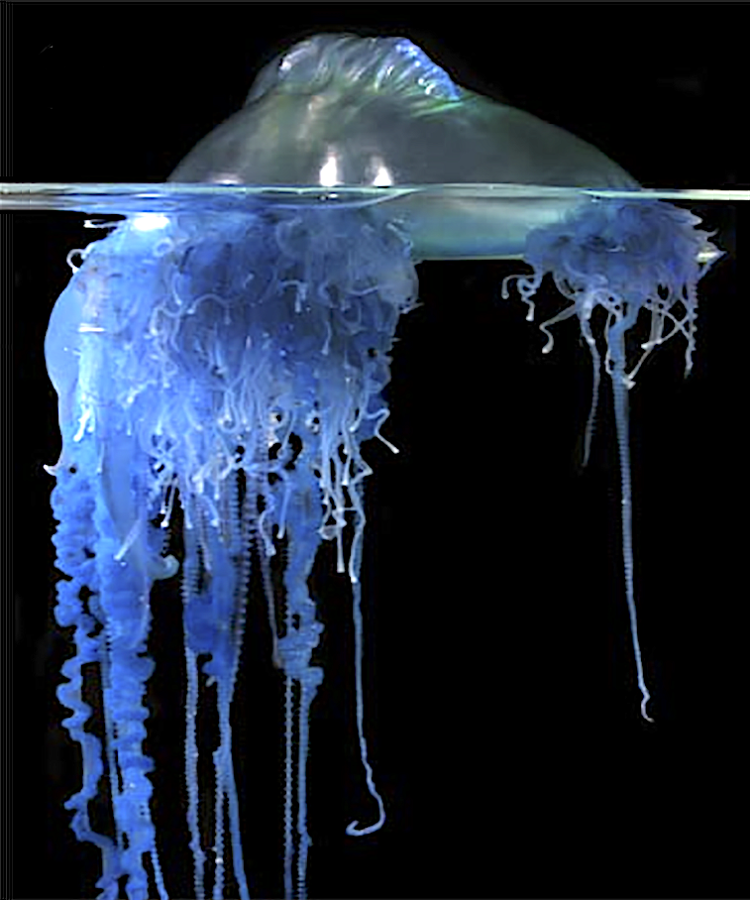
by Amayah Henderson, age 12
A common misconception is that the Portuguese man o’ war (physalia physalis) is a type of jellyfish. The man o’ war, a siphonophore, is a group of organisms closely related to jellyfish but is not actually jellyfish. Siphonophores are interesting because they are colonies of genetically specialized individuals called zooids, with various forms and functions that work together as one.
The zooids which make up a Portuguese man o’ war are a type of organism known as a polyp. The man o’ war is made of four zooids: the bladder, tentacles, digestive system, and the reproductive system. The man o’ war has a gas-filled bladder to float and its crest-like structure as a sail called pheumatophore. These features allow them to drift across the water as they cannot swim, causing them to often drift onto beaches mainly after storms.
These creatures can be found in any of earth's warm waters, mainly tropical or subtotal oceans all the way to Canada and the eastern Atlantic. They eat a variety of small animals such as young fish, plankton and crustaceans. To catch prey, the man o’ war uses its tentacles that stretch up to 30 feet delivering a powerful nematocysts. Through their tentacles that have microscopic capsules with coiled barbed tubes, they paralyze their prey with venom and pull them into their gastozooids for digestion.
The man o’ war also comes in vibrant colors such as pink, violet and blue. These bright colors serve as a warning towards animals and humans. It is important that humans stay far from these creatures as their stings can be powerful enough to leave welts on exposed skin. In fact, the man o’ war can even sting after it dies!
Although man o’ wars have a powerful sting, they have a variety of other sea animals that prey on them, such as blanket octopus, sunfish, loggerhead turtles and violet snails. There are many more details and information still to be studied about this interesting creature.
[Sources: State of New Jersey Department of Environmental Protection; Oceanservice; the Wildlife Trust]











Loading Comments...