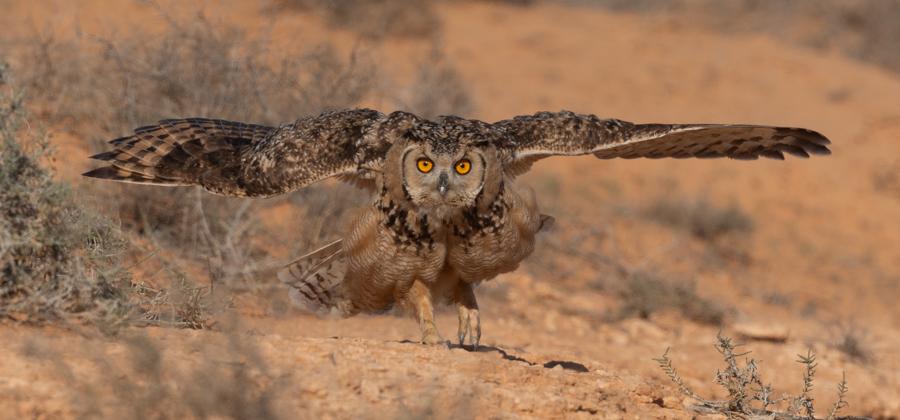
The Majestic Pharaoh Eagle-Owl
by Joseph Zheng, age 11
Many people think that the desert is just a place with insects, camels and vultures crawling and flying over the hot terrain. In reality there are many animals that thrive there and a wide variety of species who live in the desert. One such animal is the Pharoah eagle-owl.
The pharaoh eagle-owl is found in North Africa and has brown feathers with black lines that streak throughout each feather across the whole body. Its wingspan is typically 12-17 inches, and its tail is two to four inches long. Despite having an eagle in its name, the Pharaoh eagle-owl is an owl. They have a body length of 18-20 inches and weight of four to five pounds. Females are heavier and larger than males. These owls have orange eyes with black pupils. These birds have adapted in places with arid climates such as the Sahara Desert and the Arabian Desert, which are both notorious for their very high temperatures.
Pharaoh eagle-owls like to perch on rocky terrains such as mountains, cliffs, dry river beds, and even on pyramids (hence their name). This is so pharaoh eagle-owls can find and devour prey. Pharoah eagle-owls have a diet of small mammals; but they are opportunistic and will eat anything that is available including lizards, snakes, birds, beetles, desert foxes, rabbits, bats, and even scorpions.
Female eagle-owls lay two to four eggs, usually during February and March. These eggs are laid two to four days apart from each other. Females will work together with male eagle-owls to feed their young until they are 20 to 35 days old, after which the babies will be left to fend for themselves. The Pharoah eagle-owl’s main threat is poaching. People who live nearby thought that Pharaoh eagle-owls were evil spirits that brought bad luck and needed to be killed. Luckily, the Pharaoh eagle-owl is not currently at risk of being endangered.
Pharoah eagle-owls are a type of owl that have lived in Egypt far longer than humans, and if we didn’t have Pharoah eagle-owls, then humans would encounter a lot more bugs in the desert.
[Sources: The Owl Pages; Birds of the World]











Loading Comments...