Unleash the Titan
Saturn’s Largest Moon Has the Ingredients to Look Like Earth One Day
by Ashley Luse, age 12
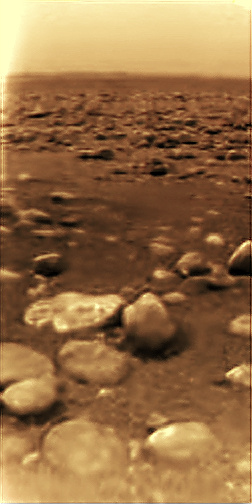
Titan, Saturn’s largest moon, was discovered
in 1655 by Dutch astronomer, Christiaan Huygens. With a simple
homemade telescope, he alerted the world to one of many secrets of
the universe.
Like most moons of Saturn, Titan does not
rotate. Saturn’s strong gravitational pull keeps Titan constantly
positioned the same way toward the planet.
The moon is surrounded by a fog of orange
clouds. Underneath these clouds is a dense nitrogen atmosphere. Titan
gets its orange color by the action of sunlight on methane, which
makes up about three percent of its atmosphere. Scientists believe
there might be rivers and seas of liquid methane or ethane.
Carbon-based molecules rain down on its icy surface with a mean
temperature of -290 degrees Fahrenheit.
The frozen moon has been considered one of the
best hopes for finding traces of life in places other than Earth.
Like Earth in its early stages, Titan has a dense atmosphere. As the
sun nears its end, it will expand and give off more heat and light.
This could warm Titan, causing it to become more like Earth. If Titan
becomes warmer in the future, the thick clouds of orange haze might
clear, allowing more of the sun’s heat and light to reach its
surface.
Titan has a good stock of organic,
carbon-based molecules that are known to be the building blocks of
life. The mixtures of these organic molecules covering its surface
could produce life sooner than we think.
[Source:
Secrets of the
Universe
]
|