Human and the Cosmos
Our Early Accomplishments in Space Exploration
by Christian Cruz, age 11
From
Copernicus to Neil deGrasse Tyson, it seems as though humans have
always been interested in going to space. The idea of space
exploration began in 1957, with the launch of the first artificial
satellite.
The
moon was the first target for space probes. The U.S.S.R.’s Luna
2 was the first spacecraft to
reach the moon in 1959. The radio controlled Lunokhods
traveled on the moon’s surface in 1970 and 1973. Space probes bring
back information from space.
The
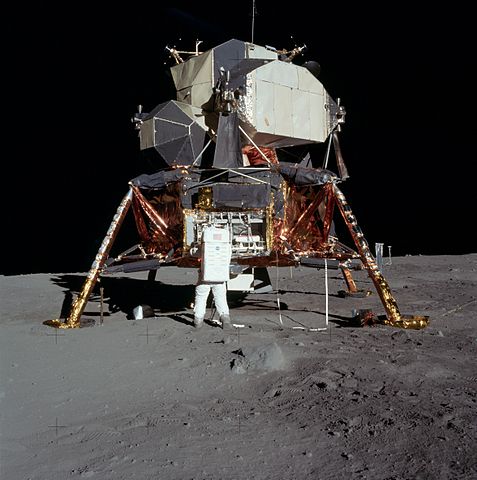
first man on the moon was U.S. astronaut Neil Armstrong in 1969. He
made history when he stepped from Apollo
11’s lunar module onto the
moon. The moon has not been the only subject of space exploration.
Space enthusiasts and scientists have also been interested in
exploring Venus.
Venus
is the planet closest to Earth, about 26 million miles away. The
planet’s surface is hidden by thick clouds, making it difficult to
get a clear picture by telescope or spacecraft. In 1967 the probe
Venera 4
found more information about Venus’ surface by parachuting through
the gaseous clouds. In 1970 several Russian probes landed on Venus
and took measurements of their surroundings. The burning temperatures
of over 840 degrees Fahrenheit made it impossible for any of the
spacecrafts to survive for more than an hour. Using radar, probes
have made possible the mapping of Venus.
Since
the launch of the first artificial satellite in 1957, the idea of
space exploration has been made possible. People have continued to
discover more about space. With today’s technology, there is no
doubt more discoveries in space exploration are just around the
corner.
[Source:
The
Kingfisher Children’s Encyclopedia; NASA
]
|