|
|
|
One of Planet Earth’s Most Fascinating Ecosystems
Coral Reefs Are Vast, Diverse, and Threatened With Extinction
by Ashley Luse, age 12
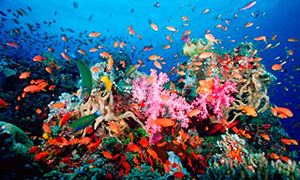
Contrary to what one might think, coral reefs are home to many sea creatures.
Coral reefs are located all over the world. They live in the
ocean and rely on moving water to bring oxygen to thier tissue and to
get rid of their waste.
A coral, or polyp, is a living
ocean plant. A polyp’s body is made up of a sac with a mouth, a gut and a
half circle skeleton. It also has tentacles. On its tentacles are sharp
objects that it uses to catch prey.
Corals can reproduce
in two ways. One way is releasing eggs into the ocean. The eggs meet
with sperm to create larvae. The larvae then move with the ocean
currents until they find a place to grow into a new coral. Another way
for a coral to reproduce is by separating into two parts, a process
called budding. During this process new polyps bud from the original
polyp’s tissue.
Coral reefs are important to ocean
ecosystems because they are home to many other sea creatures. Predators
eat smaller fish that have moved in or around the reef. These smaller
fish eat tiny organisms called plankton. Some fish avoid predators by
staying near the reef, while some just blend right in.
Zooxanthellae is a single-celled organism which lives on coral cells. It
uses the sun, water and carbon dioxide to produce carbohydrates and
oxygen, a process known as photosynthesis. This creates energy for the
polyps to grow and develop.
Photosynthesis is what
allows coral reefs to grow so vastly. But coral reefs are being
threatened by global warming, overfishing and pollution. Over 25 percent
of the world’s reefs have already been destroyed.
[Sources:
Simpson Street Free Press; Atlas of the World
]
|
|