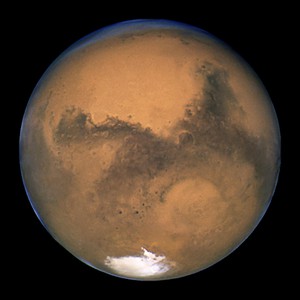
Eons ago, ancient civilizations noticed a reddish and extremely bright star in the sky. They named this star Mars. Over the course of hundreds of years, humans learned that this star is actually a planet. Space scientists discovered that the planet's days (called
sol's
), seasons, and possible vegetation are all similar to Earth's.
Days on Mars are like any Earth day in its routine. The sun rises, climbs into the sky, and sets on both planets. In contrast to Earth's 24-hour day, however, Mars has a 24 hour and 37 minute day. This difference in daytime adds up fast. The Martian year is nearly double the Earth year. In fact, a whopping 687 Earth days is equal to one year on Mars.
A year on Mars contains long Martian seasons. This is due to Mars'
axis
, or the way in which the planet is titled. The red planet is titled at 25 degrees while its neighbor, Earth, has an axis at 23.5 degrees. Despite this axial difference, Mars and Earth have the same seasons: winter, spring, summer, and fall. Mars' seasons are twice as long as Earth's are, though, because of its longer years and axial tilt.
It's possible that Mars might also be similar to Earth in terms of life forms. The possibility of life on Mars has been a controversial topic for ages. Early astronomers saw tints of green on the planet's surface as the seasons changed. They theorized that this green could be
vegetation
, or plants found in specific habitats. Because vegetation is a life form, this led scientists to wonder if there could possibly be crops, or maybe even some sense of civilization, on this known-to-be-dry planet.
The possibility of life on Mars could ultimately prove true. Spots of green, an almost identical axis to Earth's, and a similar amount of daytime to Earth's could very well sustain life and maybe even civilization.
[source:
The Mystery of Mars
]