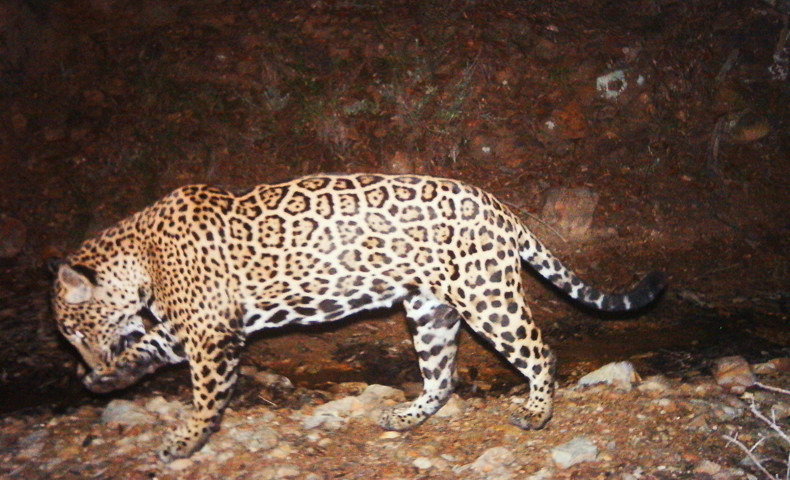
A Mysterious Jaguar Captivated Arizona Residents, then Vanished Without a Trace
by Yoanna Hoskins, age 16
Jaguars once roamed the United States. However, in the last 100 years, due to overhunting and settlement, sighting a wild jaguar is practically impossible, but not completely. There are still jaguar populations in northern Mexico and sometimes they make their way into the United States.
In 2012, the
Arizona Daily Star
reported that the remote cameras operated by the U.S. Fish and Wildlife Service captured a male jaguar in the Santa Rita Mountains. This was the first time someone had seen a jaguar moving in the United States since 2006. A nearby middle school decided to name him “El Jefe”(The Chief) and many authorities considered his presence evidence that jaguars can live in Arizona and New Mexico.
After being photographed once every 7.9 days, on average, for more than 34 months, El Jefe vanished. No one knows where he is today, but Melanie Culver, the lead investigator of the UA/Federal study, believes he may have moved to a different section of Arizona. However, a single, unpaired male is not indicative of a thriving population. In fact, since the 1990s only five jaguars have been photographed in the southwestern United States.
Around the same time that El Jefe was spotted, a mine was proposed to be built in the mountains where El Jefe was caught on camera. Conservationist Randy Serraglio said, “The Rosemont Mine would destroy El Jefe’s home and severely hamstring recovery of jaguars in the United States.” Because of this, the Center for Biological Diversity created a video protesting against the creation of the mine. However, the Wildlife Service disagrees with the Center. The Service did two biological reviews showing that the mine won’t interfere with the jaguar or destroy the places its been to. They further believe that this jaguar does not contribute to the population of jaguars in the United States since it lacks a female mate to reproduce.
While strong arguments suggest a viable population of jaguars could be established in the United States, the difficulties of introducing enough males and females from Mexico indicate this probably won't happen. Additionally, the push to develop the land will make many oppose introducing jaguars to the area.
[Sources:
Arizona Daily Star
;
Tucson.com; Scientific American; The Washington Post
]