|
|
|
Mosquito Discovery Bad News in Fight to Eradicate Malaria
by Sean Hinds, age 18
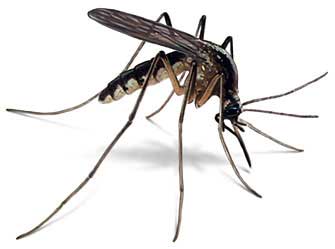
The World Health Organization estimates that 250 million people worldwide suffer from malaria, and that one million die every year from the disease. A parasite from the genus Plasmodium causes this deadly blood disease. Infected mosquitos transmit the microbe between humans by biting. The symptoms of infection include anemia, chills, fever, headaches, vomiting, and death.
Experts have long suspected that the mosquitos residing in human homes pose the greatest threat, as these insects live closest to people. They also prove to be easier to kill, which may explain why eradication efforts have largely focused on them. However, a study published in the journal Science, contradicts the theory that these mosquitos contribute most to the malaria epidemic.
Rather than attempting to catch adult mosquitos, researchers amassed thousands of larvae from puddles and wet tire-tracks around villages in Burkina Faso, West Africa. When these specimens matured in four years, genetic analysis revealed that 57 percent belonged to an outdoor variety.
Scientists then fed the insects malaria-infected human blood. Only 35 percent of indoor mosquitos contracted the parasite, compared to a striking 58 percent of the outdoor variety.
This newly discovered West-African mosquito, a subgroup of the outdoor-nesting species, Anopheles gambiae, appears highly vulnerable to infection by malaria. In addition, as an outdoor mosquito it is harder to kill.
According to Kenneth Vernick, vector geneticist at the Pasteur Institute in Paris and co-author of the study, Anopheles gambiae poses one of the greatest threats of spreading malaria in Africa. The creature has survived human eradication attempts since the 1970’s. Common methods like sprays and chemical bed netting have proved effective only against indoor mosquitos.
This new subspecies appears especially malignant, as it lives outdoors, and more easily contracts malaria. Scientists have yet to observe their feeding habits, which could be an important factor, but the insect seems much more likely to carry malaria than its indoor counterpart. Groups working to eliminate malaria may have to begin fighting on a new front.
[Source: Los Angeles Times]
|
|